How are you amazing?

One question that has helped me in my life is “How is that person amazing?”.

I try to never forget that every person I meet is in some way amazing. Awesome. In some way. I just have to find it. And whenever I search, and I mean really search, I do find it. With some people, their awesome is hidden – beneath shyness, arrogance, lack of confidence, hatred or socially acceptable behavior. But it is always there.At least that is my experience.

But all to often I do forget, and that is when I find people to be less than they really are. And that is my mistake. Luckily I am reminded of people’s inherent amazingness when someone who’s awesome shines very bright. Like the Korean talent in this video (pull out your handkerchief):

I write this post to help me never forget. And to inspire others to search for the awesome in the people they meet, and to let their own shine through. How are you amazing?

Understanding Miscavige

David Miscavige is the leader of the Church of Scientology. There is much effort spent demonizing, paint him pitch black and to point him out as the only reason why the church is in serious trouble. As far as I have seen, and I have read most of the pro and con sites on the Net, no one tries to actually understand Miscavige. So I will make an attempt to highlight a possible reason why he acts as he does.

Scientology promotes the states of Clear and OT. But no one has reached the state of Clear as originally defined by the church founder L. Ron Hubbard. And Scientology has yet to produce a stable OT.

As the leader of the Church of Scientology, Miscavige is charged with the responsibility of delivering good on these promised results. He is also charged with the responsibility of following to the letter and to the dot any and all scriptures by Hubbard. He is faced with the impossible task of ensuring a fixed process producing a fixed result.

Seeing that the results are not consistently produced (and far from it), he naturally gets frustrated. He enforces the process in order to fix the result. Seeing that the results are still not coming off the assembly line, he fixes the process further. And further. And further. All the while getting more and more frustrated. And it doesn’t take a genius to understand this frustration. Frustration leads to anger, to shouting, to slapping, to imprisoning the idiots who cannot get the process right. And he starts to enforce his own ways. Make up his own policies and rig his own processes. But alas, a fixed process still doesn’t produce a fixed result.

He probably never heard of Gödel or General Systems Theory. Had he only learned to empower people instead of the process. To assign responsibility and really help those people thrive, be creative and produce the result. But to do that, he would have to violate the sacred scriptures of Hubbard. To achieve a certain result, one needs a flexible process and flexible tools. One would need to bend or break the rules more often than one would think. Scientology is dealing in people, not the manufacturing of cars. The input (people) are uncertain, or even random – while the input to the car plant is rather set. That is why one can have a very rigid process producing cars while such a process will have the opposite effect when dealing with people as input. Witness the current state of the Church.

People (and Scientologists in particular) are prone to stigmatizing, painting the world black-and-white and swiftly calling people good (social) and evil (anti-social or Suppressive Persons). This is hardly an effort to truly understand one’s fellow man. Rather, it is mental laziness to toss stuff quickly into the white or the black bin.

I believe a situation to be more easily handled if one tries to understand it. And if the situation is a one man show, understanding the man would make it easier to handle the whole.

No one leaves this place dead

No one leaves this place dead

Just finished this play by my friend Brian Culkin. Apart from being a very good writer, he is a philosopher and teacher. And now he combines his talents into a play about life and death. I started out formulating a review of his work here, but I quickly came to the conclusion that it was too easy to give away too much. All I will say is that it’s really cool. Lots of twists an you will be stuck with it till the end.

So, instead of writing a lengthy review, I am going to leave you in a mystery – and possibly a lively discussion while I’m on a week’s vacation. Time for quality family time.

In the meantime, go get your copy over at Amazon and pitch in your views here. I am sure Brian will be around to answer any questions or discuss your views on his play.

BTW; I really liked the idea of telling a story through the format of a play like this. I just have to write a play myself. In a not unforeseeable time…

My talk on Big Data at the CiO Forum

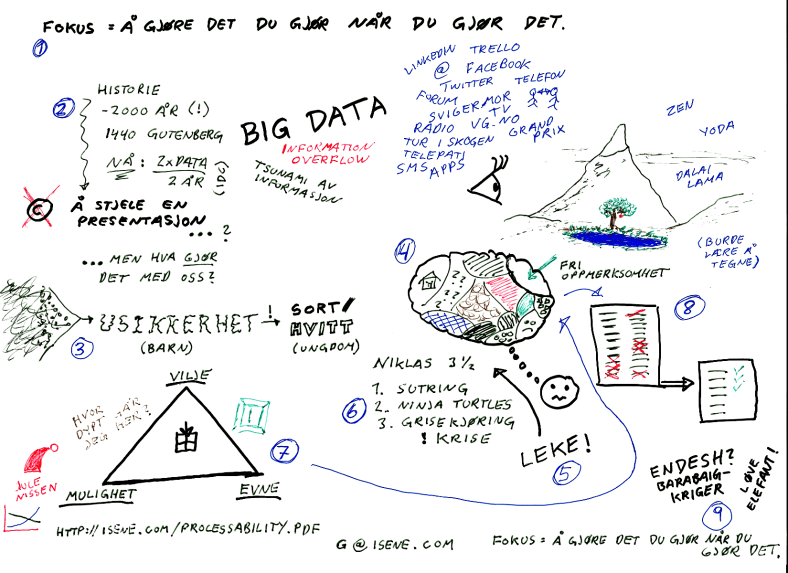
Thanks to those who contributed ideas to my talk this Thursday. I held the opening talk at the CiO Forum here in Oslo. The forum is hosted by Computerworld and there was between 100 and 200 IT executives attending.

I was about to fall prey to my own preconceived idea that I should have a set of “traditional slides” (albeit with weird twists) as the basis for my talk. I should mention that I very seldom do slides. Mostly it’s me with a flip-over dancing and jumping and gesticulating like an Italian. I tend to use people from the audience up on stage to do small role-playing scenarios, to let the audience do drills and such. But this time I was about to simmer down to conservatism when Brendan thankfully shot my slides to pieces. As he kept on questioning my approach, I realized that I was on the wrong track.

Instead I decided to take a piece of paper and draw out the concepts I wanted to cover, and true to my own website, I ended up scanning the drawing and using that as the main point of my presentation. Funny when another speaker approached me before my talk, looked at this “slide” and asked: “Is that Powerpoint… or another fancy presentation program?” “It’s pen, paper, scanner”, I replied and he looked slightly confused.

I know that most of you here don’t read Norwegian. This is as good a time as any to learn the language. Any questions – just ask 🙂

Here’s the link to the full image.

Life

Copying from Slashdot;

A recent article in Journal of Biomolecular structure and Dynamics proposes to define life by semantic voting [Note: open-access article]: ‘The definitions of life are more than often in conflict with one another. Undeniably, however, most of them do have a point, one or another or several, and common sense suggests that, probably, one could arrive to a consensus, if only the authors, some two centuries apart from one another, could be brought together. One thing, however, can be done – short of voting in absentia – asking which terms in the definitions are the most frequent and, thus, perhaps, reflecting the most important points shared by many.’ The author arrives at a six-word definition, as explained here.

Taking a look at that definition;

Life is autonomous self-reproduction with variations.

I see the key here as “variations“. Why do you think?

Processes, automation and human potential (final cut)

After a solid overhaul, and with added concepts and information, the article “Processes, automation and human potential” is now published and available on Scribd.com. It is also available here.

From the abstract:

The following article attempts to illuminate some important aspects of business and organization, such as:

  • What can and should be automated?
  • When should you trust people rather than processes?
  • What is responsibility and how can you ensure the intended production?

This article tackles the basis for automation, processes and human potential for reaching goals.

For the readers interested in Scientology – this article incidentally explains why perhaps the main policy of Scientology, the “Keeping Scientology Working” spells the demise of the subject itself.

Definition of a “cult”

When a method becomes senior to a desired outcome, and when that method gathers a crowd.

I came to this definition as a result of my latest article on process vs. output. That article has been reworked and is ready for publication. Stay tuned.

Information overflow

What happens to us as we stand in a storm of information?

The information overflow is steadily increasing. We are bombarded by information from countless channels – newspapers, TV, radio, billboards, Facebook, Twitter, e-mail, sms, Linkedin, Google+, Diaspora, Trello, e-mail lists, forums, face to face conversations, phone, phone apps, blogs…

With such a massive amount of data, how do we cope? How do we sort? How do we sift? What to trust, and what to ditch?

On February 16th, I will be holding the opening speech at the CIO forum in Oslo. And with people like you reading my blog, I would be stupid not to ask for your views.

I am not simply looking for how you think we should handle massive data, but also what it does to an individual, to our society.

Gimme your take on the human aspect of the information overflow.

Update: My post after the talk.

multitasking