People Focus with LiQUiD

Introducing LiQUiD: Light, Quick, Ultra-Dynamic.

Be water, my friend” (Bruce Lee)

Version 0.2

Credit rights: Gustavo Zaera, Geir Isene

Source (pdf)

Focus on the individual

What form should an organization take to maximize the potential of each employee? What is the ideal organization for a set of individuals? How can these questions be answered if one does not know the potential of the individuals; their abilities and motivations? And if one knows the potential of each person, then should they not do what they truly excel at?

Organizing should be based on the main assets of an organization. If the asset is natural resources, like for a gold mine, then the business should be organized around the gold mine as the main value. If the main asset is a process, like that of the Toyota car manufacturer, then the business should be organized based on the process. If the real value of a company lies in a patent, then it makes sense to structure the business to maximize the profit from that patent. If the main asset is the individual employees, the organization should be people-focused.

Most companies have an organizing board – an ideal view of how an organization should work. It describes a functional machine where employees are made to fit within it. The ideal is the cooperation, the machine. This may be the best if the machine is more important than the creative genius of each individual, or if the company has no such individuals. But if the company has creative geniuses, then that is the asset that should be the basis for organization.

So, instead of drawing the map and making the terrain fit the map, one could assess the terrain and draw a map that fits. Much like marriages have evolved – from set standards of what a woman and a man is supposed to do to the modern family where tasks are distributed across preconceived limits. Much like a local community where tasks are taken by those who are best at it. And much like most societies – where no overall organizing board exists to fit the people in a country into neat departments. Except the latter were tried in places like DDR and the Sovjet Union. A liquid organizing of tasks and people seems to be the most scalable model there is.

One could assess the employees of the company, their abilities and interests and organize all tasks around the people. And without any hierarchy of tasks, every task would be on par with every other task. “Ensuring company profit” is a task just like “manning the reception”. Tasks have different importance and size, but represent no hierarchy.

Such a liquid organizing should ensure the employees best suited for the task would be the one responsible. Add the concept of 100% responsibility and one would get employees who are fully in charge of their tasks and the expected results of each. The map would be a wall with a line of photos. A list of tasks under each picture tells what responsibilities each employee has. This puts the people in focus rather than the structure. It creates people focus.

LiQUiD is Light, Quick and Ultra-Dynamic. It helps an organization adopt easily to new tasks or new employees or new business opportunities. Without a preconceived ideal for distribution of tasks and responsibilities, it is agile to the extreme. Like water.

LiQUiD flies in the face of standard organizing models. It is pure heresay. It spells the end of organizing as we know it. The following presents a simple WOIM list outlining the basics in using LiQUiD to organize a company.

Organization using LiQUiD
  An organization has the appropriate defined Tasks 
    Suggested mandatory tasks:
      Accounting
      Delivery
      Legal
      Production
      Recruitment
      Sales
    Suggested additional tasks:
      Change Management
      Knowledge Management
      Marketing
      Media handling
      Office premises
      Process efficiency
      Quality assurance
      Staff training
      Strategy generation
      Validation & Testing
      (Etc.)
    Tasks can be big or small and can be merged or split as needed
    There are no hierarchy in organization of Tasks
      EXAMPLE: Sales is a task just like Reception or Accounting
    Organizing is clarified by a list of Tasks under each employee
    Every employee has a set of Tasks
    An employee has 100% responsibility of his or her Tasks
      Tasks = Capabilities AND Motivation
        Capabilities = What the employee can do
          Ensure the employee is also free to tackle new territory
        Motivation = What the employee wants to do
          Ensure the employee is motivated to extend the comfort zone
          Foster a culture of directness where saying "no" is also Ok 
    Ensure each Task is clearly defined
      Exactly defined inputs
      Exactly defined outputs/deliverables
        Defined metrics for the outputs/deliverables
          AND/OR: 
            Quality target for outputs/deliverables
            Quantity target for outputs/deliverables

People Focus using LiQUiD organizing may have the potential of making an amazing splash.

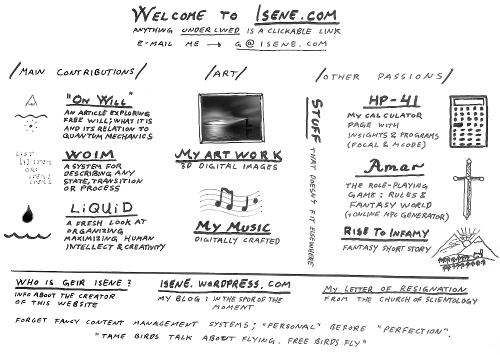
New design on isene.com

I finally got around to redesigning my website.

It’s been like this for a few years now:

Now it looks like this:

I know, it’s a crazy idea… no structure, not at all professional, only a drawing… OMG WTF? BBQ!

But it’s all there. Even a new revolutionary take on organization (I’ll make that a separate blog post later).

Hop on over and check it out.

On Will

The sun, the sailing and the beauty of Greece warmed my heart and gave inspiration to finalize an article “On Will”. I collected my previous articles on free will, the origins of Cause and on Quantum Mechanics, added concepts and forged a more complete article outlining a theory that hopefully will spark some interest in others.

The article is published on my www.isene.com

Let me know what you think.
Or better, apply your sharp critical skills and try hacking it to pieces.

Dreams

I believe there is much to gain through control of one’s own dreams.

On one hand your dreams can be your future reality. Gaining control of those dreams and ambitions will serve you well.

The other types of dreams happens when you are asleep. These represent your own imagination, your own universe if you will. Gaining control of these nightly activities may prove quite useful as they are the gateway to creativity and to imposing your own on the common reality around you. Maybe the two types are but aspects of one.

Ever since I was a child I had some control over my dreams at night. I could conjure scenes and populate them with people, things and monsters. I could sometimes decide I could fly. Or be invulnerable. But often the dreams got out of control and happily so. Except when the monsters got out of control, then it became a nightmare. I would often know that I was dreaming, and sometimes I could press myself to wake up from a nightmare.

Dream

A maze

The coolest experience I ever had while asleep was when I conducted an orchestra while I on the fly composed the music – violins, cymbals, clarinets and the rest of the ensemble. That was incredible. In fact I couldn’t believe I was doing it, so I decided to wake up to find out if I got the music as an external influence from outside my dream. As I woke up, I could hear the silence of the night. No music. Nothing. So I got back to sleep and picked it up from where I left it, only this time I decided to up it a few notches; I decided to mix the classical orchestral piece with Billy Idol’s “Hot in the city”. That was freakin’ amazing.

A few notable out-of-control nightmares kept returning – stuff that just wasn’t controllable. I would say there was a 30% chance in any given week that I would have a nightmare – pretty constant throughout my life. Until I finished OT 8 (a spiritual level in Scientology) four years ago. Since then, I have not had one single nightmare. If that would have been due to sheer chance, it would compare to picking up one single predefined proton on the way between our Sun and our nearest neighboring star (Proxima Centauri) (the chance is roughly 1 in 4*10^31). Albeit one of the very small gains from doing OT 7 and 8, it is still a distinct one.

I would argue that one of the symptoms of gaining more control of my life has been how well I can “play” my dreams – both while asleep and awake. Both are cool – but playing out my dreams with others in the game of life is the coolest.

Extrapolating “free will

Let’s extrapolate the concept of free will with a wild abandon.

If there exists potential free will, free of any physical restrictions, that free will cannot have been created as time is a physical property. Thus the free will supersedes the physical universe, or co-existed with the physical universe if it has always been here.

As the free will causes changes in the physical universe, it represents the “cause” and space, energy and time is the “effect” of the free will acting.

Now if the physical universe is truly “effect” it is not capable of causing anything – it has no will of its own. The free will on the other hand can not be affected by anything except by its own choice. Therefore, anything that the free will experiences is by its own volition. By choosing otherwise, the free will experiences otherwise.

While the physical universe is total effect, the free will to be truly free is total cause.

Whereas free will changes by its own choice, its choice may be swayed – by its experiences and thus its choices. A feedback mechanism is then seen as the free will chooses its own experiences and is then affected by them. This may lead to the free will apparently loosing control of its will by association and believing it has less free will. It will then act as less free, less “cause”. To change this feedback mechanism, the free will can be coerced by an other free will to believe it is more “cause” and less “effect” and hence bring the situation under control of the free will once again.

Any coercion will do as long as the free will believes the solution presented will work. This may explain how many people are helped by a wide plethora of practices aimed at bettering the individual. It may also explain the Placebo effect.

A few notes:

  1. In this discussion of the free will, one could simply reduce the it to a descussion of whether “will” exists at all. Forget “free will”. Does “will” exist? If the answer is “yes”, reality is neither purely deterministic and/or random. “Will” is that other factor beyond determinism and quantum randomness.
  2. By “choice” is meant the possibility of “will” being exercised.
  3. A case can be made for the physical universe and the many “wills” within it being a whole rather than two separate concepts – where the physical universe is the result of a consensus of the “wills” involved.