An Open Letter to Scientology critics

The Church of Scientology has gone down the drain. It is perpetrating abuses daily and that makes many people angry.
It is easy to blame. Much harder to understand. Much harder to respect other’s beliefs and gains.
What if the gains some people reports from Scientology is real?
What if Scientology did do them a world of good?

Would you rather they didn’t have the gains?

My talk on Big Data at the CiO Forum

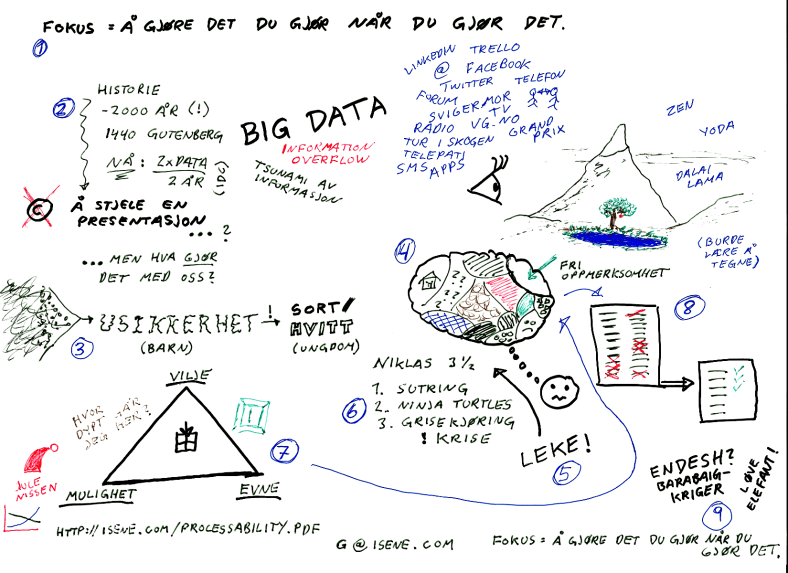
Thanks to those who contributed ideas to my talk this Thursday. I held the opening talk at the CiO Forum here in Oslo. The forum is hosted by Computerworld and there was between 100 and 200 IT executives attending.

I was about to fall prey to my own preconceived idea that I should have a set of “traditional slides” (albeit with weird twists) as the basis for my talk. I should mention that I very seldom do slides. Mostly it’s me with a flip-over dancing and jumping and gesticulating like an Italian. I tend to use people from the audience up on stage to do small role-playing scenarios, to let the audience do drills and such. But this time I was about to simmer down to conservatism when Brendan thankfully shot my slides to pieces. As he kept on questioning my approach, I realized that I was on the wrong track.

Instead I decided to take a piece of paper and draw out the concepts I wanted to cover, and true to my own website, I ended up scanning the drawing and using that as the main point of my presentation. Funny when another speaker approached me before my talk, looked at this “slide” and asked: “Is that Powerpoint… or another fancy presentation program?” “It’s pen, paper, scanner”, I replied and he looked slightly confused.

I know that most of you here don’t read Norwegian. This is as good a time as any to learn the language. Any questions – just ask πŸ™‚

Here’s the link to the full image.

Life

Copying from Slashdot;

A recent article in Journal of Biomolecular structure and Dynamics proposes to define life by semantic voting [Note: open-access article]: ‘The definitions of life are more than often in conflict with one another. Undeniably, however, most of them do have a point, one or another or several, and common sense suggests that, probably, one could arrive to a consensus, if only the authors, some two centuries apart from one another, could be brought together. One thing, however, can be done – short of voting in absentia – asking which terms in the definitions are the most frequent and, thus, perhaps, reflecting the most important points shared by many.’ The author arrives at a six-word definition, as explained here.

Taking a look at that definition;

Life is autonomous self-reproduction with variations.

I see the key here as “variations“. Why do you think?

Choices, choices…

Looking to buy a new car, a house, an HP calculator or a new telescope. Looking for the perfect job? The perfect employee or the perfect girl? Or deciding between a set of possible choices and having a hard time making up your mind?

There is a simple tool that I have used many times when faced with difficult choices (including that of finding the perfect girl). It requires you to simply list all the important items in a requirement specification and giving each item an importance or “weight” (any scale will do). And then as you are faced with each case to evaluate, give that case a score on each item in the list of requirements. A simple example:

If you are to recruiting a new employee, the specification would consist of items such as “relevant knowledge”, “relevant job experience”, “proven production record”, “communication skills” or “empathy”. You would give each item a certain weight where “relevant knowledge” could be given a weight of “4” while “empathy” for this specific job could be given “2” in weight.

When a requirement specification is populated with a list of weighted items, it’s time to pitch a set of cases against the specification. You figure out the scale you want to use and put a score on each item of the requirement specification for the case you evaluate. The scale goes from “0” to any number you set as the maximum score. A candidate for a job could score a “3” on “relevant knowledge” and a “5” on empathy on a scale from “0” to “5”. You then multiply the score with the item’s weight to get the “weighted score”. So even though the candidate receives a maximum score on empathy, she only gets a weighted score of “10” on that item compared to “12” on “relevant knowledge”.

Finally, you sum up all the weighted scores, divide by the sum of the item weights, divide by the maximum score and multiply with 100. Then you have a total percentage score of how well that case fits the requirement specification.

A tool? What do you mean with “a tool”?

You want a tool to help you create a requirement specification with a list of weighted items and then to easily manage and evaluate many cases against it?

Sure, I have that. Do you have an HP-41 calculator?

I know, I know. It’s a stupid question. Of course you have the best calculator ever made sitting right there on the table and in daily use no less.

Then I will supply you with this neat evaluation program utilizing a new trick; dynamic menus.

What’s that? Well, head on over to my calculator’s page and check it out. Choosing the perfect girl is at right your fingertips.
Change of pace

I am trying out less moderation on this blog. This means that posters with previously approved comments will have their new comments auto-approved – they will show up immediately. This should make for a more dynamic and smooth discussions as I will not have to read and approve every single comment.

Go frolic!

Processes, automation and human potential (final cut)

After a solid overhaul, and with added concepts and information, the article “Processes, automation and human potential” is now published and available on Scribd.com. It is also available here.

From the abstract:

The following article attempts to illuminate some important aspects of business and organization, such as:

  • What can and should be automated?
  • When should you trust people rather than processes?
  • What is responsibility and how can you ensure the intended production?

This article tackles the basis for automation, processes and human potential for reaching goals.

For the readers interested in Scientology – this article incidentally explains why perhaps the main policy of Scientology, the “Keeping Scientology Working” spells the demise of the subject itself.