People Focus with LiQUiD

Introducing LiQUiD: Light, Quick, Ultra-Dynamic.

Be water, my friend” (Bruce Lee)

Version 0.2

Credit rights: Gustavo Zaera, Geir Isene

Source (pdf)

Focus on the individual

What form should an organization take to maximize the potential of each employee? What is the ideal organization for a set of individuals? How can these questions be answered if one does not know the potential of the individuals; their abilities and motivations? And if one knows the potential of each person, then should they not do what they truly excel at?

Organizing should be based on the main assets of an organization. If the asset is natural resources, like for a gold mine, then the business should be organized around the gold mine as the main value. If the main asset is a process, like that of the Toyota car manufacturer, then the business should be organized based on the process. If the real value of a company lies in a patent, then it makes sense to structure the business to maximize the profit from that patent. If the main asset is the individual employees, the organization should be people-focused.

Most companies have an organizing board – an ideal view of how an organization should work. It describes a functional machine where employees are made to fit within it. The ideal is the cooperation, the machine. This may be the best if the machine is more important than the creative genius of each individual, or if the company has no such individuals. But if the company has creative geniuses, then that is the asset that should be the basis for organization.

So, instead of drawing the map and making the terrain fit the map, one could assess the terrain and draw a map that fits. Much like marriages have evolved – from set standards of what a woman and a man is supposed to do to the modern family where tasks are distributed across preconceived limits. Much like a local community where tasks are taken by those who are best at it. And much like most societies – where no overall organizing board exists to fit the people in a country into neat departments. Except the latter were tried in places like DDR and the Sovjet Union. A liquid organizing of tasks and people seems to be the most scalable model there is.

One could assess the employees of the company, their abilities and interests and organize all tasks around the people. And without any hierarchy of tasks, every task would be on par with every other task. “Ensuring company profit” is a task just like “manning the reception”. Tasks have different importance and size, but represent no hierarchy.

Such a liquid organizing should ensure the employees best suited for the task would be the one responsible. Add the concept of 100% responsibility and one would get employees who are fully in charge of their tasks and the expected results of each. The map would be a wall with a line of photos. A list of tasks under each picture tells what responsibilities each employee has. This puts the people in focus rather than the structure. It creates people focus.

LiQUiD is Light, Quick and Ultra-Dynamic. It helps an organization adopt easily to new tasks or new employees or new business opportunities. Without a preconceived ideal for distribution of tasks and responsibilities, it is agile to the extreme. Like water.

LiQUiD flies in the face of standard organizing models. It is pure heresay. It spells the end of organizing as we know it. The following presents a simple WOIM list outlining the basics in using LiQUiD to organize a company.

Organization using LiQUiD
  An organization has the appropriate defined Tasks 
    Suggested mandatory tasks:
      Accounting
      Delivery
      Legal
      Production
      Recruitment
      Sales
    Suggested additional tasks:
      Change Management
      Knowledge Management
      Marketing
      Media handling
      Office premises
      Process efficiency
      Quality assurance
      Staff training
      Strategy generation
      Validation & Testing
      (Etc.)
    Tasks can be big or small and can be merged or split as needed
    There are no hierarchy in organization of Tasks
      EXAMPLE: Sales is a task just like Reception or Accounting
    Organizing is clarified by a list of Tasks under each employee
    Every employee has a set of Tasks
    An employee has 100% responsibility of his or her Tasks
      Tasks = Capabilities AND Motivation
        Capabilities = What the employee can do
          Ensure the employee is also free to tackle new territory
        Motivation = What the employee wants to do
          Ensure the employee is motivated to extend the comfort zone
          Foster a culture of directness where saying "no" is also Ok 
    Ensure each Task is clearly defined
      Exactly defined inputs
      Exactly defined outputs/deliverables
        Defined metrics for the outputs/deliverables
          AND/OR: 
            Quality target for outputs/deliverables
            Quantity target for outputs/deliverables

People Focus using LiQUiD organizing may have the potential of making an amazing splash.

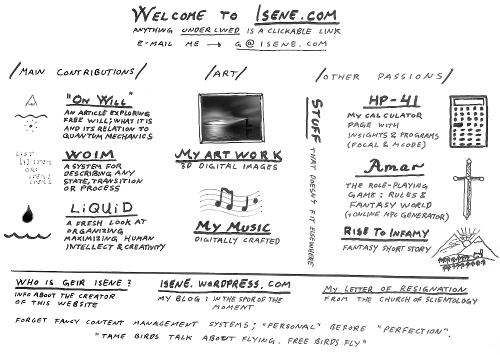
New design on isene.com

I finally got around to redesigning my website.

It’s been like this for a few years now:

Now it looks like this:

I know, it’s a crazy idea… no structure, not at all professional, only a drawing… OMG WTF? BBQ!

But it’s all there. Even a new revolutionary take on organization (I’ll make that a separate blog post later).

Hop on over and check it out.

WANTED! Value in LRH admin tech

Continuing my reexamination of Scientology information accepted at face value, I am tackling the whole of LRH admin technology.

But before I dive into the technology itself, let me briefly cover from where I do this reexamining:

I have been an executive in companies for more than 23 years, 17 of them as a CEO – mostly very successful. I have studied LRH admin tech intensively while I was the CEO of U-MAN Norway from 1990-2000. I have implemented the LRH Org Board in several companies as well as Admin Scales, LRH communication systems, management by statistics, recruitment tech, marketing tech etc. I have also studied other management philosophies such as the ISO 9000 series, Six Sigma, Lean/TPS, ITIL, COBIT, PRINCE2 and a few others. I have extensive experience with ITIL and also PRINCE2. With this as part of the back-drop, let’s dig in.

The management philosophy in Scientology was created by L. Ron Hubbard for managing the various Scientology churches and organizations. The Organization called WISE (World Institute of Scientology Enterprises) was set up to promote this LRH Admin Tech. On the web site, we find:

“We disseminate the administrative works of renowned author and philosopher L. Ron Hubbard to use in organizational, professional and private endeavors. The product of more than three decades of research, piloting and codification, this body of knowledge is the world’s most comprehensive system of management and represents the first true technology of management.”

…and also:

“WISE is a fellowship of thousands of business people across the globe who recognize that the organizational and management principles developed by author L. Ron Hubbard have application to all businesses. And that where used, they greatly increase the prosperity and growth of an organization.

For 25 years WISE and its members have been disseminating these principles to business people everywhere.”

…and then:

“Our two greatest assets are the uniform workability of L. Ron Hubbard’s organizational and management principles, and the dedication of our members.”

While the latter may be true, I dispute the “uniform workability of L. Ron Hubbard’s organizational and management principles”. In fact I dispute it’s overall workability. WISE has even gone so far as to call it “The only workable administrative technology“. Really?

Let’s take a few examples:

Recruitment: Hubbard teaches an organization to recruit many staff in parallel and then keep a big back door open for those who fail. I dispute this hire-and-waste principle. I believe it to be disruptive and detrimental to an organization.

Manning up an organization: Keeping an admin/tech ratio of 2 to 1, meaning you would have only one third of the personnel delivering billable service. Do the math. What service organization can survive with this over-administration without the use of slave labor?

Management by statistics: Weekly statistics. Several statistics for each post. Managed from top-down. I have seen this creating frantic and neurotic organization with little long-term vision.

The organizing board: Hierarchical, over-administered with people stuck in boxes of responsibility and where very few are able to fulfill the implicit responsibilities of the vertical they are in charge of.

The three-basket system: Out-dated. Somebody invented the computer.

The handling of opposition: The LRH management principle here is to “always attack, never defend“, to handle any attack by discrediting the source, to dig up or invent something bad to shut up the opposition. Seriously.

These are but a few examples of non-workability within LRH admin tech. And while I have had excellent success using the Administrative Scale, having helped more than a dozen organizations and more than 250 people personally with this tool, I can also here see an even better and more workable way.

As WISE promotes; thousands of members have for more than 25 years been busy disseminating and implementing LRH admin tech. Given that this is “the only workable administrative technology”, surely there must be some stellar examples of its implementation. Right there at the top of Wall Street. Or the UN. Or the humanitarian organizations. Or… somewhere? Even the Church of Scientology is not a good example of its implementation – anything can work when you build an organization using what would normally pass for slave labor.

Are there any factual examples where LRH administrative technology has proven beyond doubt to be more successful than other management systems?

And so I return to the title of this blog post: Please help me find actual proven valuable parts of the management framework created by L. Ron Hubbard.

I am not about to go to any extreme here. I am an advocate for taking what works and using it where it proves valuable. I am simply struggling to list many factual workable parts of LRH admin tech, and not just small bits like “the concept of the ideal scene” or “bits and pieces in the marketing series”. I am looking for whole parts that have proven to be uniformly successful.

Anyone?

Rotten attitude

When a friend of mine came out an accident and in dire need of help, she turned to a fellow scientologist. She told my friend that she wouldn’t help because she could not get into such “entheta”, being an OT VIII and all.

An other friend of mine turned to his OT VII and VIII friends for some assistance only to be told that it was beneath them to help someone at his level.

If this seems bad, it’s nothing compared to a fellow scientologist here in Norway who refused to work for a friend’s company for a rather sickening reason.

The company collected money for a group of musicians with Down’s Syndrome, making it possible for them to put up concerts and perform. And they are great performers even with their disabilities.

The reason for turning down the job offer? He didn’t want to contribute to such degraded beings (DBs)!

If it is something I’d like to see slayed before sunrise, it is this haughty, arrogant, I-am-better-than-them attitude that I more than a few times saw with dedicated scientologists. It’s a rotten attitude.

Shedding mental lead

It may be inevitable. It could be that no person is immune to the mental laziness of dropping one’s guard and sacrificing one’s personal integrity in the face of great success or real failure.

All the Scientologists I have met have accepted large or small portions of Scientology by faith rather than by inspection. Their personal experiences have shown them that parts of Scientology has great workability. Maybe it was the communication course, maybe their Dianetics sessions, or the moment they went Clear or an OT level that got them real and tangible gains or maybe something entirely different.

From those successful experiences and gains comes the acceptance by extrapolation. “If that was so excellent, then this must surely also be great“. And thus preconceptions are born.

This of course also works the other way; Presented with some real failure, something really bad, one can get preconceptions as well. Just like some person having bad experiences in Scientology or reading something negative about the subject can become cemented in “how bad it all is”.

A person can become hyper-critical or gullible by extrapolating his experiences.

And so it has been also with me. Although I have tended to inspect a great deal myself and tried very hard to not let my personal integrity slide, I have not been immune to this extrapolation effect.

There have been areas that I have not inspected and trusted at face value. Such as parts of the Admin Tech (the administrative technology developed by L. Ron Hubbard for the organizing of Scientology organizations). I have seen some clear successes with this technology and with that concluded that some other piece of Admin Tech must surely also work equally well. Or, I have jumped to the conclusion that what I have seen as successful must surely also work really well in a totally different setting or field.

And this is wrong.

Take but one example: Even though the Organizing Board developed by L. Ron Hubbard can be an excellent tool, it can also be dead weight. In some areas it can work well. In other areas it can straight-jacket an otherwise thriving organization. It is surely not the silver bullet I once thought it was.

Realizing one’s preconceptions is an important step forward in regaining one’s personal integrity. Shedding such mental lead is the road to regaining oneself.

In the last year I have had ample space to reexamine my own preconceptions and mental lead. And it is coming off, layer after layer.

I no longer think that the Admin Tech is so special. It is perhaps a good way to organize a Church of Scientology. Perhaps. But to extrapolate that into thinking it’s “the only workable administrative technology” (as trumpeted by the World Institute of Scientology Enterprises – WISE), or even good for a particular business is folly. It’s a just a tool, and a business needs the tools suited for that business to operate successfully. And so the Org Board was the latest holy cow slaughtered on the altar of progress. Just yesterday.

Nothing is holy like that. Everything is workable to a certain degree in a certain setting. And there really is no substitute for finding out by real examination. Not by faith or trust or skepticism or distrust.

The answer lies in really LOOKING. For oneself.

Is Scientology for everyone?

A friend of mine that I met while doing OT VII (one of the highest spiritual levels in Scientology) told me an interesting story about his wife’s relation to Scientology.

You see, she was not a Scientologist, and they had been married since the 70’s when he got into Scientology and she had no interest in the subject. He tried early on to get her interested, but to no avail. Other Scientologists tried to get her interested, but nope, “not for her” she said.

It became an issue with the church that my friend was moving up the levels and being married to a non-scientologist. He got in trouble for this and more effort was put into converting his wife. He got frustrated – both because he couldn’t get her to see the light and because it was getting to be a situation with the church. And so he decided to write to Hubbard for advice on how he could get his wife to become a Scientologist. This was back in the 70’s when Hubbard was still in communication with his public.

He got back a very different answer than what he was hoping for. After acknowledging my friends letter, Hubbard simply said:

Scientology is not for everyone

I thought that was an interesting answer.

Any time thereafter when the church would bring up the issue of his non-scientologist wife, he would simply point to the letter.

On Will

The sun, the sailing and the beauty of Greece warmed my heart and gave inspiration to finalize an article “On Will”. I collected my previous articles on free will, the origins of Cause and on Quantum Mechanics, added concepts and forged a more complete article outlining a theory that hopefully will spark some interest in others.

The article is published on my www.isene.com

Let me know what you think.
Or better, apply your sharp critical skills and try hacking it to pieces.

Silence…

It is quiet here these days because me and my family is on a sailing vacation, only occasionally on the net 🙂

I’ll be back in full force at the end of July.

Will try to drop by and approve comments every few days.

Obsessing over the Man

Who cares who said it? Who cares if it was Einstein, Hitler, Bach, Obama or the Easter Bunny? Who the frak cares?

The question is rather: Is it any good what whoever said?

It’s fascinating the mental laziness that some people indulges in. Discredit the source and the message dies. O RLY? Is that the logic of today’s revolutionaries? Or worship the source and anything sourced becomes gospel. Oh C’Mon!

What fallacy. Yes, it’s called Argumentum ad Hominem. And yes, I’ve been bitching about this before. And I think this will be my last repetition in trying to get some seriously dimmed down people to understand that a fact, statement or opinion stands or falls on its own merits. Regardless of who uttered the words.

Be bright enough to really examine the words themselves and don’t resort to lazy tricks to get others to toe your line.

The obsession about the Man is the one thing that the Church of Scientology Party-Line Toers and the Hard Core Critics most visibly have in common. It’s the sheer stupidity they share.

In the church it’s even policy to discredit the attacker to discredit his message.

It doesn’t matter whether the Man is L. Ron Hubbard, David Miscavige or some other Guy In Command. The obsession makes the obsessed look stupid.

I know the intended audience of this message won’t get it when I say; Get off it. But some others just might get the idea and not fall into the Rabid Hole.

source

Above

Living life. Deciding I can choose.
Making choices. I can win. I can loose.
Playing life. Painting another theme.
Looking ahead. Deciding I can dream.
In a dream. Deciding I can fly.
No more looking at days go by.

Above

Above

Artwork created using Vistapro and GIMP.