Here it is. In Norwegian only – the Interview I did on the program “TRUDE/”;
Thanks to AnonymousNorway for delivering this.
If you know Norwegian and are up for a challenge, then subtitles are very welcome 🙂
Here it is. In Norwegian only – the Interview I did on the program “TRUDE/”;
Thanks to AnonymousNorway for delivering this.
If you know Norwegian and are up for a challenge, then subtitles are very welcome 🙂
“If you do, the owner will kill you“. Brendan and I looked at each other in amusement and back at Amani; “You’re joking, right?” “No, the owner WILL kill you“.
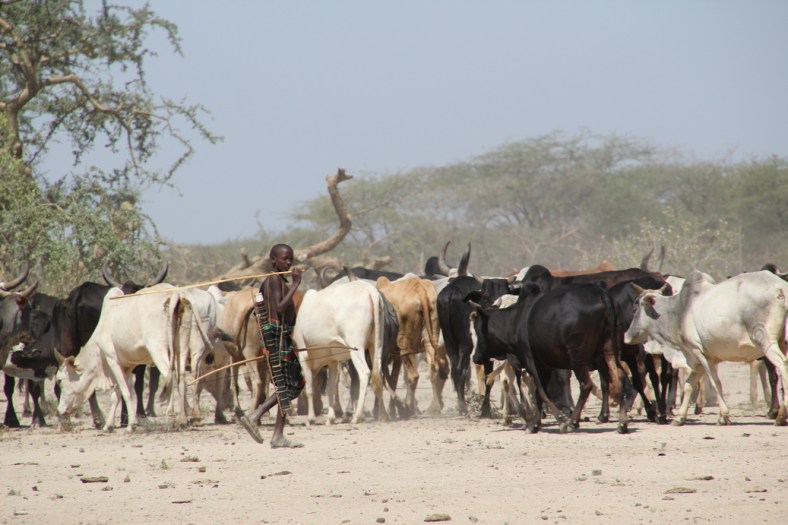
Note to self: "Don't touch the cows"
Brendan had just instructed an ITIL course in Dar es Salaam. Amani was one of the very bright attendants, an amazing person on so many levels. When he heard that we wanted to present the ITIL framework to the Masai people, he told us about the five villages that his father had discovered in 2005. Amani senior, the District Commissioner for Karatu had found some 5000 people of his tribe that had been left out of the civilization, and Amani asked if we wanted to go visit them instead of the Masai. We were on a mission to document if you really could “Heal the world with ITIL” as the slogan for the itSMF conference in Oslo had touted. When the conference had asked for presentations last autumn, we sent a few lines describing a talk we could hold; “The African Case“.
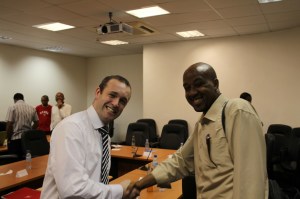
The amazing Amani
We were to go to Africa and document if one could indeed make any real change in the world with an IT organization framework. You think we are kidding? Nope, and neither did they. They happened to approve our talk and we found ourselves equipped with a reason to go off to Tanzania for some real adventure.
 Our original idea was to go to the most outback of places, a place where they hadn’t even seen a PC to give a talk on ITIL and see how the Masai would react. When Amani suggested an even more uncivilized place – off the civilized map, we jumped at the opportunity. We were to meet the Masai’s only fear – the Barabaig.
Off we went to the North, landing in Kilimanjaro International Airport and by Bus to the hotel in Arusha. Next day we went to Karatu where we met Amani’s sister, Teddy who took us on a safari at Lake Manyara.

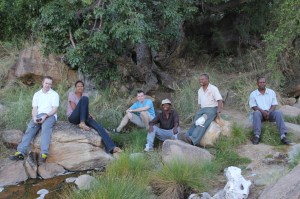
Adventure in the wild
In the evening we had dinner at the District Commissioner’s house. Amani senior told us about his tribe, the Barabaig and their culture and history. Although they live side by side with the Masai, they compete for grazing land and sometimes they get into fights. The Masai have adopted a name for the Barabaig, which translated to English becomes “bad enemy”, giving an indication of who’s to fear. The history of the tribe is interesting and troubling and left us with an impression that they are tough survivors possessing qualities that are rare in the Western world. The Barabaig are many, but most of them have been swallowed by the Tanzanian culture. The village we were going to the next day was pure Barabaig, the unadulterated, the original.
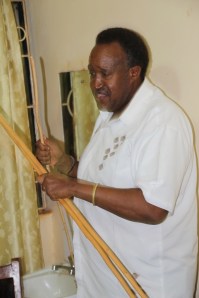
"Barabaig" means "hitting the sticks"
Amani senior was an inspiring and very knowledgeable man, funny and with great initiative. What he lacked in temper, he would make up for in passion. His family supports some 200 kids in secondary school through their non-profit organization. And his son, our friend Amani, is engaged in a project to supply several schools in Dar with IT equipment. We heard of how this family donates a sizable amount of their salary and time to projects benefiting communities and were impressed with their creativity and dedication.
One guy must have missed this year’s Paris Dakar race, because if the District Commissioner’s driver had competed, he would surely have won.
We drove from the end of civilization and for four hours through the wilderness at crazy speed before we came to Endesh, one of the five forgotten villages. Amani senior had arranged for a school to be build last year – not by donations, but by encouraging the villagers to sell some of their cows to buy building materials and let them build the school themselves.
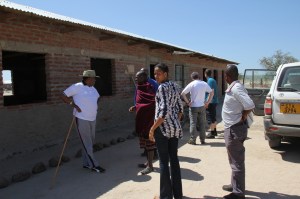
The school in Endesh
We parked outside the school building, the driver jumped out of the car, slaughtered a goat and we got back in to drive to the place where they fetched water every day.
The two hour trip back and forth to the water source gave the village cooks time to prepare the goat in our honor. As the first two white people in the village, we were more honored than they, and soon to be more humbled than ever.
The village elder went with us up to the top of the green and lush hill. He showed us the water and talked about the life of the Barabaig and the situation in the village where they have to walk some 15 kilometers every day to get to this spring. Knowing that the Masai traditionally had to kill a lion to become a man, I inquired; “Have you ever killed a lion?” “No“. We crossed the stream. “Have you ever killed a rhinoceros?” “No“. We got to a nice open space. Just to top it all; “Have you ever killed an elephant?” “Yes“.
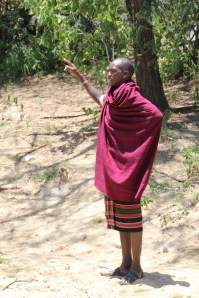
Chief pointing to the water source
“Uh? What??” “How?”
He told us the story of when he was 14, equipped only with a spear, he stood some 7 meters away from an adult elephant. In an intense moment, he had launched himself sideways and while the elephant had flapped his ears and thus exposing an area of 3 inches in diameter where he could thrust his spear and penetrate into the brain. But only after snapping his hand and causing both ends of the spear to vibrate in order to get through the tough skin. Had he missed, he would have been dead.
Already at the age of 4 the Barabaig children are responsible for herding some cows. Together with other children between 4 and 12, they take cattle far away from the village to some decent grazing grounds only to return just before the sun sets. Once in while some Masai teenagers decides to steal some cattle from the kids. After taking the kids and the cattle many more kilometers away from the Barabaig village, they beat the crap out of the kids and run away with the cows. Several hours later the kids would perhaps have managed to crawl back to the village to report about the theft. The Barabaig warriors would then grab their spears and marche to the Masai to reclaim their property. And then some. To teach them a lesson, they take twice as many cows back. And then it’s war. Back in the olden days, this would end in a blood bath. Nowadays, the Tanzanian army will intervene, and at gunpoint order the factions back to their own villages.

The man with the greater achievements
It’s a hard life where only achievements matters. It matters not that a man is the most handsome, throws the spear the farthest or runs faster than the other in the village. Only achievements matters.
When a kid becomes a man, he will choose his woman. The ceremony starts and at the end, every aspiring man will proclaim the wild animals he has killed. And with every kill there must be witnesses. The first man may have killed a leopard. This would be trumped by two leopards, which in turn would be dwarfed by a lion which would be puny compared to killing an elephant. The man with the most achievements picks a woman first. And the man with the least achievements is left with the last woman standing.
It is all about achievements, about 100% responsibility, about no excuses and about pulling together as a tribe. Attitudes that are few and far between in the our society.
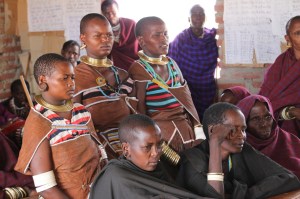
In the school
We returned to the village and people started to gather in the school. Actually, they started to crowd the classroom. And we were faced with the challenge to present ITIL to the attendants. I had drawn a map on the blackboard to show where we came from. The District Commissioner shook his head; “The don’t know what a map is”. I commenced by trying to explain that the country of Norway was very far from Tanzania. Again he shook his head; “They don’t know what a country is. They don’t know that they live in Tanzania“. I then tried to explain how many days it would take to drive from our place to Endesh. Another shaking of the head; “They don’t have that concept of time“. I gave up; “It’s veeeeeery far that way“… I pointed.
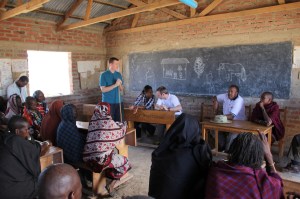
On Change Management
We talked about responsibility and about Change Management. We asked about their greatest challenges in life. Interestingly enough, processes and ITIL was not on the top of their list. Rather it was: Water to the village, medicines, schooling and better communication between the villages (they had apparently seen cellphones). Processes? Nah. They where into 100% responsibility. And that trumps Business Process Management any day of the week and twice on Mondays.
Their attitude humbled us. We realized that they have more to offer the world than the richest country on the planet. So we decided to make a trade: We supply water to their village and they supply attitude to Norway.
Back in Norway in March we made our talk at the itSMF conference in Oslo. Apart from emotionally moving the attendees, several decided to pitch in. We announced that 20% of the course fees for our standard (hell, it’s way above standard when Brendan delivers it) ITIL Foundation would go toward the Endesh water project. It will cost anything from USD 70K-700K. In return, we will get one of their toughest warriors to Norway to teach 100% responsibility to our business community, on radio and TV and hopefully to the members of Parliament. The first warrior with excellent achievements that learns to speak good English will visit us for a few months. And we will be getting the best deal.
When Endesh gets their water, they will be able to utilize the school all all year around as then they won’t have to travel far in the dry season for their cattle to graze. And the government will not so easily treat them like dirt if some politician decides to claim their land for some new project – like they did in the late 60’s, almost throwing that part of the country into civil war.
This trip changed us both. Brendan and I will never be the same again. We will go back. And we will help Endesh get their water supply. And we will get a dose of their attitude exported to our part of the world.
Want to pitch in? If you are in for some serious adventure, raise your hand. Or better, leave a comment to this blog post.

Is it a todo-list manager? Is it an outliner? A project management tool? A shopping list solution on steroids? A way of designing business processes? A way to describe… the human DNA or the solution to mankind’s problems or the whole freakin’ universe?
Yes, yes, yes. It’s all of the above. It’s WOIM! And it is out in version 1.4
With this version, I have added time repetition (thanks to Nilo de Roock) and checkboxes for items – with optional date stamps for items that are Done (thanks to Christopher Truett).
No, this is not a piece of software. It is a description for how you can describe anything. And I do mean anything.
 If you want a software solution to go with it, learn VIM and add the accompanying VIM plugin. Then you have all you need to comfortably write neat WOIM lists and use it for anything from shopping lists to the description of Quantum Mechanics. It’s yours to take, and you are welcome.
From a discussion on the ITIL Alumni LinkedIn group:
Brendan Martin:
Geir and me have several ideas a week for possible projects. Some of these ideas are tested, some succeed but most fail. We don’t mind. If you don’t shoot, you will never score.
Our latest idea is different. It is so simple. I still however believe that maybe 1000 people around the world were thinking of the same idea at the same time we sang “Eureka!”.
But first, what makes simple ideas succeed. I wonder why Dropbox succeeded, why Twitter succeeded, why Facebook succeeded, why the ipod succeeded. All of these ideas had competition. Maybe they all had great business plans but few actually got the idea “in the zone”. Learning to put your ideas “in the zone” gives them energy. Along with perseverance, simple ideas may succeed.
“Twenty years from now you will be more disappointed by the things that you didn’t do than by the ones you did do.” Mark Twain.
Geir Isene:
The nay-sayers are almost always right; “No, no that idea will never work”. Because most ideas fail in execution. This is also how they treat their own ideas before they even get spoken. And that is why they never try. And to prove their own rightness, they will try to convince everybody around them that their ideas will also fail.
But our creative fellow, the yeah-sayer, is a hopeless optimist, never giving up – even after a thousand ideas have been shot down, he still musters the stupidity to give it another shot. And once in a blue moon, a crazy idea does succeed – sometimes against all odds, sometimes because it slips by before anyone could see it to shoot it down.
And then you get real change. Real positive impact.
WOIM is a methodology to describe anything – any state, item(s), pattern, action, process, transition, program, instruction set etc. So, you can use it as an outliner, a ToDo list handler, a process design tool, a data modeler, or any other way you want to describe something.
I just released version 1.3
A few minor errors were corrected and one important feature was added; The ability to reuse any part of a WOIM list based on context. It is now very easy to write a process that can be reused without using a reference or duplicating the process. An example would be if you wanted to tell someone to first do something with “apples”, then do the same sett of actions with “oranges” and then with “grapes” (like peeling them and cutting them to small pieces or something). You would simply write the procedure like this:
[apple,orange,grapefruit] Make ready for putting it into the cake
 Peel
 Cut into small pieces
 Sprinkle some sugar on the pieces
The document describing WOIM in detail is available at the usual place.
Having reached an overall conclusion as to the workability of L. Ron Hubbard’s management system, it is time to take care of the babies in the bath water.
First on the list is Hubbard’s main principle regarding recruiting staff to an organization. He writes that one should hire based on results and not based on personality*.
I used to run a recruitment company for 10 years (U-MAN Norway) – from 1990 until 2000. The recruitment business is rife with opinions on how to conduct interviews, what to emphasize when evaluating a candidate etc. But nowhere did I see such a cut-to-the-chase as Hubbard’s.
U-MAN originally based its recruitment services solely on the OCA test (The Oxford Capacity Analysis is the test devised and originally copyrighted by Julia Lewis-Salmen and used by the Church of Scientology). Although the OCA test is a remarkable tool for assessing personality, it is a far cry from a whole recruitment process.
For the first half of the 90’s U-MAN sold the test and was happy doing just that. But sometimes the candidate we recommended turned out to be a mis-recruitment. Perhaps 10-20% of the time. It is a testament to the excellence of the OCA test that such a high percentage of recruitment success was achieved with the test as the main focus.
An effort was made to come closer to 100% recruitment success.
And the Hubbard’s recruitment focus was stressed, and very rightfully so, by the owner of U-MAN International, Mårten Runow. With the focus of uncovering the actual production record of a candidate during the interviews, the success rate of our recruitments jumped to a whooping 93% – probably the highest in the industry.
I have later done recruitments without the OCA test and with the main focus on the candidates earlier results. From this I conclude that one should be able to achieve some 85%-95% success without the use of personality tests but with the main focus on earlier results.
Further progress was made with the use of even better reference checking and with devising specific skills tests for various jobs. We finally reached a success rate of 97,4% before I left the company in 2000. I believe this to be by a margin the best recorded success rate in the industry.
It is not that other recruitment companies didn’t focus on an applicants proven production record. They sometimes did, but never consistently and earlier results were often overshadowed by other factor such as personality, school grades, presentation skills etc.
The moral of this blog post would be that a company would do very well by shifting the focus in recruitment to a diligent uncovering of a candidates earlier production results.
The way to do this is quite simple (here’s a WOIM list):
Recruitment interview (in part)
  Ask the candidate for his/her main results in life
    What is he or she is proud of achieving in life?
      Emphasize results created for others
  [?] The candidate has earlier job experience
    [1,3] Earlier job positions
      Ask what results/products the candidate was supposed to produce
      Ask how the candidate would measure those result
      Ask the candidate to draw a graph showing production over time
      Ask the candidate to explain any ups or downs in the graph
      Ask for a reference that can verify these results
There is of course a lot more to the whole recruitment process, but with these data, you can better evaluate which candidate to hire.
*) After having spent more than an hour trying to find the exact reference where Hubbard describes the main focus of recruitment, I gave up and realized again the need for the project LRH4ALL.
 Geir Isene - uncut