HP-41 in the dark

Yes, I have the same problem as you. When you feel the urge to program your precious Hewlett Packard HP-41 calculator in the middle of the night, you would have to turn on some light source. A lamp would wake up your wife or the kid that decided to occupy half of your bed. You need a small light source.

And when you are out with your telescope inventing new ways to justify the use of your 30 year old calculator, you need some light source that doesn’t kill your night vision.

A while back I made a plug-in module for my HP-41CX that had a LED attached to two wires coming out from the module. As I didn’t know which of the internal module pins to solder the wires to, I ended up with a Porta-Lite module where the LED would always be on regardless if the calculator was turned on or not.

Yesterday I decided to open up the module and do it right this time.

Yes, it’s a simple hack. And for those hardware gurus over at the HP Forum, this would seem pretty trivial. But for me, a predominant software guy, it’s a small hill. A small hack, but a useful one.

Ok, “pics or it didn’t happen” – so here they are:

On bringing up children; a small episode

When my oldest son was about three years old, an interesting episode in the young boy’s life played out.

He was screaming for an ice cream. Full of tears and emphasized by volume, he sooo wanted that ice cream.

I sat down and said: “If it helps to scream, you should scream a lot. Because it helps. But if it doesn’t help, you might as well stop. The choice is yours“.

I waited a few seconds. The young boy wiped his tears and looked at me.

Why did you stop“, I asked. “Because it doesn’t help“, he replied.

What do you think will help?“. Thoughtful. A second later he said “Daddy, if I help you with that and that (pointing), can I get the ice cream then?“.

That’s a pretty good deal. Yes, then you deserve the ice cream“.

He happily devoured the cone of ice. Finished, I asked “Did that help?“. “Oh yes!“, he exclaimed.

After that such screaming became rare 🙂

For the calculator nuts: Free42

Obviously you have a number of HP calculators on your desk and in the showroom glass cupboard. And obviously you are addicted to the RPN method of calculating. But now and then you are away from your precious toys and stuck with your phone or PC with a much less than optimal “calculator” program.

Here’s a tip: Get yourself a copy of Free42 by Thomas Okken.

The Free42

It’s the coolest desktop/mobiletop calculator in town.

Just my 2 cents.

Linux: Conky

Up until 1999 I was mindlessly following the mainstream and used Windows as my desktop operating system. Then I tried Linux and never looked back. I have since also tried other free OS’es like OpenBSD, NetBSD, DragonFlyBSD, Plan9 and others.

My laptop runs Ubuntu Linux but without any desktop environment like Gnome or KDE. I prefer to run the Pekwm window manager directly on X. It’s got all I need; Being very flexible, configurable, lightning fast, rock stable and most importantly, unobtrusive. No task bar. No pop-ups (when I see the Windows desktops nowadays, I wonder how people can stand the constant pop-ups and the over-glorified eye-candy pulling the user’s attention).

I like minimalistic. Simple.

For many years I used the GKrellM system monitor to show me the status of memory, disk, wifi link, the clock with date, speaker volume, moon phase, weather forecast, new e-mails in various mail boxes, etc.

The other day I came across Conky. Now this is one piece of cool software. The most configurable and extensible information presenter I’ve ever seen. You can make Conky do just about anything. It will show any information you need directly on you desktop.

I decided to make a configuration file with just the information I need, on the top of my desktop. I added two entries to my Pekwm configuration file to reserve the top 30 pixels on my desktop for Conky (so no windows will ever cover that top screen space):

EdgeSize = “30 1 1 1”
EdgeIndent = “True”

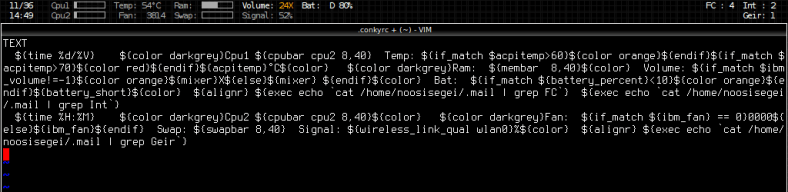
Below you can see my Conky in action with an urxvt terminal with Vim showing the last part of my “.conkyrc” configuration file (the part that creates what you see on my Conky).

Simplistic as it is, nothing beats my setup with regards to speed and productivity.

There are a few cool features added such as the volume changing to orange color whenever it is mutes, when the temperature goes above 60°C, it is shown in orange and above 70°C it is shown in red and battery is shown in orange below 10% capacity.

The upper left numbers are the day of the month and the week number in the year. The stuff to the far right are unread e-mails in three different mail folders.

Conky is a nerds wet dream. Excellent stuff.

Formalizing a description of existence

Continuing my quest for a description of existence, I have taken a look at the very basics and attempted to formalize some conclusions – as usual in the form of a WOIM list:

Potential
Realization
[1,x] Existence
   Cause
   Consideration
   Effect
   Influence
      #Existence
Common reality = Intersection of existences
Consensus reality = Co-considered effect
   [2,n] Cause
   Consideration
   Co-considered effect
   Influence
      #'Consensus reality'

In even plainer English, this means: There is a potential which realized becomes existence. Existence is comprised of Cause which through consideration creates an effect which in turn influences the Existence. From this we get the fractal nature of the universe.

Common reality is simply two existences overlapping (intersecting), while a Consensus reality is an agreed-upon existence, or more precisely “co-considered” effect, again with the fractal nature of the effect influencing back at the Consensus reality.

This WOIM list condenses the essence of my article “On Will“. It is very far from a formalized description of the basics of existence, but it may serve as a starting point.

I would appreciate feedback (but please read the above referenced article first); Is the list correct, and what are the next steps in making it more complete?

More on your rights to your own viewpoint

It was 1994, aboard the Scientology cruise vessel MV Freewinds. It was my first trip to the ship and I signed up for the ship-only course “Secrets of the MEST universe” (MEST = Matter, Energy, Space & Time). It was a wonderful course – struck right to the core of my nerdiness. It enhanced my understanding of physics, a field I have been deeply in love with since my childhood.

Plugging away in the course room, I encountered a word I didn’t know and looked it up in a dictionary. It had a couple of different definitions that both could fit – but the meaning would be very different depending on which definition I used. I called the supervisor.

I don’t know which of these two definitions to use. And the meaning of the sentence will be very different if I pick that one over the other“, pointing in the dictionary.

Scott looked at me “What do you think?

Well, I think it would be that one“, moving the finger to the second definition. Scott looked at me, said “Thank you” and walked away.

Must have been lucky“, I thought.

The next day I was faced with a similar situation, only this time it was even more difficult to figure out which definition to use.

Scott, come over here… there is this word…blah-blah-blah“. Scott countered “Well, what do you think?“. Me: “Oh, I think it’s this definition“.

Thank you“, turning around and attended to another student.

Three is a charm, and an hour or so later I raised my hand. Scott looked over. “Nah, forget it“, taking my hand down. Scott smiled and said “Now you get it“.

For this and many other reasons, he is the best supervisor I’ve ever had.

You just got to take responsibility for your own observations, your own viewpoints and your own learning.

In the article “How to study Scientology” (Ability Magazine, Feb 1959), Hubbard writes:

You are asked to examine the subject of Scientology on a critical basis—a very critical basis.

So then we ask you to look at Scientology, study it, question it, and use it as we present it and you will have discovered something for yourself. And in so doing you might well discover a lot more.

When you have applied it as it should be, and applied as it is taught at the school, and still find it unworkable, it is your privilege to question it and, if you like, reject it.

When disagreement is forbidden

In the Church of Scientology it is always your fault if you disagree with any material. You have misunderstandings (M/Us – yes it’s right there in M4), you have a lack of mass and need to clay demo the concept, you have transgressions in the area (Overts), you are PTS (a Potential Trouble Source), or you’re just plain stupid.

The material is never wrong. You are.

Even when the materials are later claimed to have been wrong in the first place (ref. Golden Age of Knowledge), it is still you that were at fault.

So what happens when a person disagrees with the material while taking a course in the CoS? He gets sent to the word clearer. He gets cleared right down to the last dot. If that doesn’t work, you get sent to the Qualification Division to get your understanding of the material sorted out. Still disagreeing? Then there is always the ethics officer. She should be able to fix you.

Somewhere along the line, the student will either a) really believe he is the one at fault or b) invent some odd way to make the materials right – by paper clips, chewing gum or some other MacGyver hack.

The student ends up invalidating his own viewpoint (or he ends up quitting the course). Making less of his own viewpoint and understanding, he ends up making less of himself. His personal integrity starts to slide. He blanks out his own viewpoint and is really “not quite there” as a student to really evaluate that material anymore. He becomes robotic. He starts blindly trusting the material just as he starts to blindly distrust himself every time a pesky disagreement comes creeping in. He becomes more fanatical.

Robotic. Fanatic. I have seen that. Have you?

First principle in recruiting

Having reached an overall conclusion as to the workability of L. Ron Hubbard’s management system, it is time to take care of the babies in the bath water.

First on the list is Hubbard’s main principle regarding recruiting staff to an organization. He writes that one should hire based on results and not based on personality*.

I used to run a recruitment company for 10 years (U-MAN Norway) – from 1990 until 2000. The recruitment business is rife with opinions on how to conduct interviews, what to emphasize when evaluating a candidate etc. But nowhere did I see such a cut-to-the-chase as Hubbard’s.

U-MAN originally based its recruitment services solely on the OCA test (The Oxford Capacity Analysis is the test devised and originally copyrighted by Julia Lewis-Salmen and used by the Church of Scientology). Although the OCA test is a remarkable tool for assessing personality, it is a far cry from a whole recruitment process.

For the first half of the 90’s U-MAN sold the test and was happy doing just that. But sometimes the candidate we recommended turned out to be a mis-recruitment. Perhaps 10-20% of the time. It is a testament to the excellence of the OCA test that such a high percentage of recruitment success was achieved with the test as the main focus.

An effort was made to come closer to 100% recruitment success.

And the Hubbard’s recruitment focus was stressed, and very rightfully so, by the owner of U-MAN International, Mårten Runow. With the focus of uncovering the actual production record of a candidate during the interviews, the success rate of our recruitments jumped to a whooping 93% – probably the highest in the industry.

I have later done recruitments without the OCA test and with the main focus on the candidates earlier results. From this I conclude that one should be able to achieve some 85%-95% success without the use of personality tests but with the main focus on earlier results.

Further progress was made with the use of even better reference checking and with devising specific skills tests for various jobs. We finally reached a success rate of 97,4% before I left the company in 2000. I believe this to be by a margin the best recorded success rate in the industry.

It is not that other recruitment companies didn’t focus on an applicants proven production record. They sometimes did, but never consistently and earlier results were often overshadowed by other factor such as personality, school grades, presentation skills etc.

The moral of this blog post would be that a company would do very well by shifting the focus in recruitment to a diligent uncovering of a candidates earlier production results.

The way to do this is quite simple (here’s a WOIM list):

Recruitment interview (in part)
  Ask the candidate for his/her main results in life
    What is he or she is proud of achieving in life?
      Emphasize results created for others
  [?] The candidate has earlier job experience
    [1,3] Earlier job positions
      Ask what results/products the candidate was supposed to produce
      Ask how the candidate would measure those result
      Ask the candidate to draw a graph showing production over time
      Ask the candidate to explain any ups or downs in the graph
      Ask for a reference that can verify these results

There is of course a lot more to the whole recruitment process, but with these data, you can better evaluate which candidate to hire.

*) After having spent more than an hour trying to find the exact reference where Hubbard describes the main focus of recruitment, I gave up and realized again the need for the project LRH4ALL.

The flawed management system

My recent reexamination of LRH admin tech sparked some interesting discussions – some on this blog and more on other forums and mailing lists. I would like to follow up and addresses a rather odd stance taken by some.

While nobody can point to a successful implementation of LRH’s management philosophy (the admin tech) some justify this by pointing to one or more of the following:

a) No-one is trained well enough to implement it
b) People have M/Us (misunderstandings) regarding the tech
c) The admin tech will not work in the presence of suppression
d) The tech has been altered (presumably by others than LRH) sufficiently to render it unworkable as a system
e) Too few know about it – hence there are too few implementations for significant statistical data.

Let’s take up each of these:

a) Nowhere have I seen such an emphasis on training in any management philosophy than in the Church of Scientology, and it only barely works there due to slave labor. If the management philosophy would require even more training to see to its success, then what we are looking at is such a complex system that it fails to carry its own weight.

b) If a management system requires flawless understanding of it to make it work, it is a failure compared to the many other management systems that works very well with people even sloppily trained on it.

c) The admin tech is supposed to be the perfect way of handling suppression.

d) Why did the admin tech not include elements that guarded it from such alterations? Also, other management philosophies have been altered far more and still works very well. This is called evolution.

e) WISE (World Institute of Scientology Enterprises) claims: “Hubbard management technology has been applied in more than 140,000 companies across the globe. At the root of this success is its consistent workability — where it is exactly applied it uniformly brings growth and prosperity to businesses and organizations of all sizes.” I would call that significant statistical data – yet nothing but small companies with Scientologists as owners step up claim it successful.

The fact remains; There are no visible successful implementation of LRH admin tech – “successful” implies a significant positive deviation from the mean of the market in which it is implemented. If there are I will surely stand corrected.

If the lack of success should be attributed to some other factor than mere unworkability, should that not apply equally well to other technologies – like voodoo, flat-earth science, psychiatry, breatherianism, et al.?

I understand how some really would want LRH admin tech to be the “only workable management system”. But it isn’t. It’s not even close. As a system, it’s a failure. This is not to say that there aren’t babies in this bath water and that one should chuck out the whole lot. There are great bits an pieces in there – especially in the Management Series (three books containing several series of policies, including the PR series, Personnel series, etc.). As always, pick what works.

Hubbard teaches in his admin tech to look at the actual results to judge a systems workability. If he is right in that, then the admin tech is flawed. If he is wrong in that, well… that lesson is part of the admin tech, and hence it is flawed.

I advocate applying Occam’s razor to this; LRH admin tech as a whole system is seriously flawed.