Got an article up at Elephant Journal called “What is Reality?”
It should strike right to the core of what I also write about on this blog. Check it out, and please leave a comment over at the Elephant’s.
Got an article up at Elephant Journal called “What is Reality?”
It should strike right to the core of what I also write about on this blog. Check it out, and please leave a comment over at the Elephant’s.
I have just co-written an article over at the Elephant Journal together with Brian Culkin.
Brian is an amazing guy, a good friend, and now also my yoga teacher.
Check out the article. I would ask you a favor; Please leave your comments over at the Elephant Journal rather than here at my blog. Thanks.
In February of 1959, L. Ron Hubbard wrote an article in the Ability magazine called “How to study Scientology”. It’s one of my all time favorites from LRH. In this article he says:
“You are asked to examine the subject of Scientology on a critical basis—a very critical basis.“
I feel it is time to review some Scientology basics and see if they really do hold true. And to do this properly, we would use the method of falsification – if we could find situations where a principle is untrue, we would know that the principle is not a universal truth.

So, how about the very basics of basics in Scientology, the ARC triangle? Is it always true that Affinity, Reality and Communication is interdependent? Is it always true that raising or lowering one of the corners would result in a raising or lowering of the other two? Could we find actual examples that falsify this? Or could we at least formulate instances that could be used to test the ARC triangle to see if it could be falsified. And if we cannot falsify it despite putting the principle to test, we would in fact have strengthened the theory.
Ready for the challenge? Then read the links first and post your comment.
Update (2011-08-20): The task is simply to find situations where a person could have a skewed combination of Affinity, Reality, Communication and Understanding. Could we find a situation where a person was in total agreement but without any significant affinity or communication. Or could there be a situation where the person had great affinity for something he did not understand or completely disagreed with? Or any other combination that would falsify this statement:
“Every point on the ARC triangle is dependent on the other two, and every two are dependent on one. One can’t cut down one without cutting down the other two, and one can’t rehabilitate one without rehabilitating the other two. On the positive side, one can rehabilitate any point on the triangle by rehabilitating any other point on it.“
Hot off the press; WOIM version 1.5 now includes the possibility for encryption. The VIM plugin can now be used to encrypt/decrypt parts of a WOIM list or even autoencrypt/decrypt a WOIM file. I can now use WOIM for everything – including a password safe.
You can’t have a fixed procedure produce a fixed result in a world where randomness or free will exists.
The Heisenberg’s uncertainty principle shows that you cannot know both a particle’s momentum and position at a given time. You can only measure a high probability for either of these.
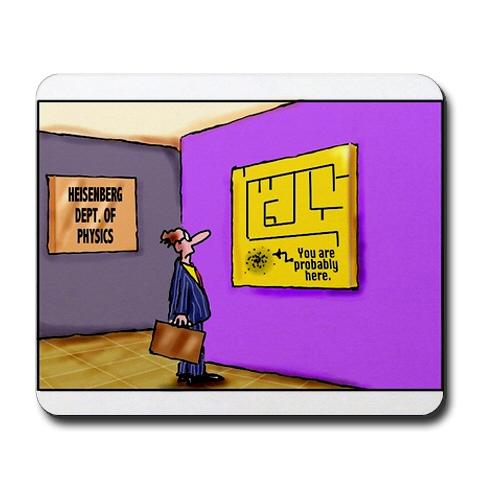
Gödel’s Incompleteness Theorems tells us that no system can be both complete and consistent. You must choose; A system that is complete and inconsistent, or a system that is consistent and incomplete.
And a corollary to Gödel’s comes from the field of Systems Theory and points out that a fixed procedure will create variable results and a fixed result requires a variable procedure. You must choose – a fact very few business process managers are conscious of. Trying to implement a fixed procedure to obtain a fixed result is folly. Most often you would want a certain result – and hence you must allow for individual creativity and a loosely defined procedure. This is the basis for Adaptive Case Management.
Thinking that you can program a business like a machine will most probably lead to some interesting situations.
Realizing that you can’t have your cake and eat it too may just free up some mental stress.
Apple threatens Exxon as the most valuable company on Earth. Nations are faced with an ever increasing debt problem.
I have written about the Ant Hill Innovation earlier. As the world faces increasing economic challenges, it seems the rationale behind patents and copyrights are increasingly questioned.
As Apple is squelching opposition, many start wondering if offering companies monopolies is such a good idea. What would the world have been like if Tim Berners-Lee had patented The Web 20 years ago?
With even The Economist weighing in, the future is hopefully dimmer for those who want to secure their own at the expense of the many:
“…it is next to impossible to offer a new technology or software-driven service without getting sued for patent infringement.”
and
“At a time when our future affluence depends so heavily on innovation, we have drifted toward a patent regime that not only fails to fulfil its justifying function, to incentivise innovation, but actively impedes innovation. We rarely directly confront the effects of this immense waste of resources and brainpower and the attendant retardation of the pace of discovery, but it affect us all the same. It makes us all poorer and helps keep us stuck in the great stagnation.”
It is time to rethink the patent and copyright regimes.
It is succinctly summed up over at TED:
What do you think the world would be like if there were no patents or copyrights?
I have been working professionally with Open Source software and Free Software since 2000. I have gotten to know a great many excellent developers, many work in my own company, FreeCode. But today I would like to acknowledge a person who inspires a passion I have, a hobby a cherish.
As Open Source (or even Free Software) has gone mainstream, there are Open Source developers seemingly everywhere. From the large communities like Linux (kernel, core programs, utilities, applications and various distributions), portal software (Drupal, Mediawiki, etc.) and games (Battle for Wesnoth being my favorite) to more esoteric projects.
As a reader of my blog, you may have picked up my fascination with old HP calculators and the programming of the HP-41. Especially the really low level programming in assembler, called MCODE (Machine CODE) for the HP-41. It is in this arena that I would like to acknowledge my Open Source hero.
Ángel Martin excels at MCODE. He excels at documenting MCODE. He is a learning machine and a teaching machine. He’s got more contributions to the HP-41 MCODE than you could shake a stick at and he shares his contributions freely. And he’s a social and very likable guy – not like the many Gollums who succeeds before a machine but not amongst people.
Yes, Ángel Martin is my Open Source hero.
It dawned on me a while ago that I could not come up with an example of any quality that could not be satisfactorily expressed in some quantities. I was a bit puzzled by this, but other interests grabbed my attention and so I let it go. Today a stray thought led me to this question once more: Is there actually such a thing as a quality that cannot be otherwise expressed as a set of quantities?
And here’s a very cool Hugh:


Nourishing my hobby, I have been playing with cryptography on my favorite tool.
Now you can have perfect security for a file of up to 300 characters on the little calculator-computer.
If you happen to be interested, you will find the program at the usual place (isene.com).
I really enjoy programming the HP-41 🙂
And now that I have the newly created motherboard replacement (called the HP-41CL) from Monte Dalrymple (Systemyde), I will get to upgrade my HP-41 to massive memory and 50x speed. It’s X-Mas in August.
After sailing in Greece since the beginning of July, we arrived back home in Oslo yesterday.
Today we went downtown to see the area struck by the terror attack and most importantly the memorial place covered with more flowers than I have ever seen in my life.

Strangely the air was filled with calmness and warmth where one could expect confusion and revenge. Sadness yes, but carried by a foundation of love – for those who lost their lives, for the democracy they championed and for our national integrity. I am proud to be a Norwegian. May this horrific event forge a companionship stronger than ever.
In these days of healing there are of course some elements that we could do without. There are those who seek to score political points, those who will use the events to peddle their ideologies and those who will try to solicit PR in the wake of sorrow. Like the staff in the Church of Scientology in Oslo that I met close to our own Ground Zero. They were there on a recruiting mission via The Way to Happiness Foundation – as if a moral code is what the people of Norway need the most right now. The usual practice for the church is to ensure any such event would be used to bolster their image. Knowing that the church actually works hard to support a power hungry cult leader makes such exploitation of willing staff a disgrace.
In times like these I honor those who give unconditional help, those who give without thought of reward.
 Geir Isene - uncut