Life. Make it happen.

Did some more experimenting with music and video, this time also using text-to-speech.

This is a small step toward an idea that Brendan gave me last night; That I should put together lots of quotes from the contributors on my blog, add some crazy music and make that into a video… But there are 20000 comments, so if you can help me out with some golden quotes from this blog – or at least some worthy for a video – then I would be very grateful.

Update: Added another – Drive:

Transcend Exchange

exchange

Noun:

  1. An act of giving one thing and receiving another (esp. of the same type or value) in return.

transcend

Verb:

  1. Be or go beyond the range or limits of (something abstract, typically a conceptual field or division).
  2. Surpass (a person or an achievement).

L. Ron Hubbard stresses the concept of exchange in many of his policy letters. In the policy letter from 1982 titled, “Exchange, Org Income and Staff Pay”, he delineates cllearly his take on four levels of exchange:

First consider a group which takes in money but does not deliver anything in exchange. This is called rip-off. It is the “exchange” condition of robbers, tax men, governments and other criminal elements.

Second is the condition of partial exchange. The group takes in orders or money for goods and then delivers part of it or a corrupted version of what was ordered. This is called short-changing or “running into debt” in that more and more is owed, in service or goods, by the group.

The third condition is the exchange known, legally and in business practice, as “fair exchange.” One takes in orders and money and delivers exactly what has been ordered. Most successful businesses and activities work on the basis of “fair exchange.”

The fourth condition of exchange is not common but could be called exchange in abundance. Here one does not give two for one or free service but gives something more valuable than money was received for. Example: The group has diamonds for sale; an average diamond is ordered; the group delivers a blue-white diamond above average. Also it delivers it promptly and with courtesy.

While this sounds well and good, it has dawned on me lately that there is something missing. Perhaps the most important level is missing – a level dear to my heart. I would see it as a level above all these four:

The transcending of exchange. It’s the level of not caring about echange, of “giving without thought of reward”, of “practical karma theory”, of give-give-give. This flies in the face of standard operating Scientology where you are taught “to get your exchange in” and to ensure “others get their exchange in”, where flows need to be balanced, where one only gives with thought of, or even demand for, reward.

Fuck that. Just give. I belive that is the core of life.

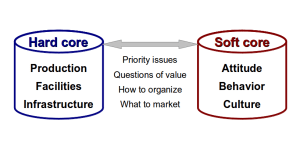
Hard Core to Soft Core

Just got around to write down more of our ideas (Brendan and myself) in a document titled “Hard Core to Soft Core”.

Here’s the abstract:

How do the soft assets of an organization relate to the hard assets? How does an organization change its culture? How does the structure of an organization relate to its people, products and processes?

These are but a few of the questions this article examines. It highlights the relationships between the various elements of an organization — from the hard core physical assets to the soft, intangible human elements.

Here’s the document: http://www.scribd.com/doc/94065549/Hard-Core-to-Soft-Core

Self-therapy

I am an unstructured, rather chaotic person. Ideas and thoughts all over the place. I do manage to collect the ideas and bring many to fruition. But the process is often marked by improvisation and experiments. I try, I fail, I succeed, I fall and I get up again. More structured people may find this hard to follow, annoying or even hopeless.

Ever since I was a child I have looked at ways to structure my processes. HyperList is a culmination of this efforts, but there have been many more or less structured efforts at collecting my thoughts and ideas into neatness. It is a kind of self-therapy.

Maybe that is how many if not the majority of methodologies are created. It has been argued that L. Ron Hubbard created Scientology to handle his own issues. Just like many may opt for studying Psychology to straighten out their own mind. It may reveal a lot about the person’s own problems by looking at the methodology he is selling to others.

Maybe Christ was insecure about his own faith in God? Maybe Buddha struggled with chock from his first encounter with pain and suffering? Maybe Freud had deep sexual issues? Etc.

And precisely because of this one should be well aware of one’s own issues, what one wants to handle, if anything, before one adopts a specific path. Maybe a certain path is not the right one for you, or not just now. It may be the right one for it’s originator. Maybe even for millions of others. But there may be another, better path for you. And if not, then you could just create your own.

And when you sell the right path for you to other people, be aware that it may not be what they need or want.

I will continue to sell the most eminent descriptive system, HyperList, but I do realize it is not for everyone. Nor is my take on the connection of Will and Reality, or my upcoming work on Anchorbreaking.

I believe that no one possess the key to unlock every door. You have in your hand the key to unlock yours.

As for my own; I can warmly recommend the book “A perfect mess“.

Assumption

Religions, therapeutic practices or ideologies often base their methodologies on an assumption about what you want to achieve.

In Judaism, Christianity and Islam the goal would be to serve God and to have a union with God and to reach Paradise. Nirvana can be seen as a goal of Buddhism, whereas Hinduism promotes four goals. Various branches of psychology serve to work toward less irrationality, less mental suffering or even more obedience. Yoga attempts to let the person become aware of her deepest nature. In Scientology, your goal is to reach total freedom. Other ideology goals can be harmony, enlightenment, awareness, knowledge (as with science) or peace or love.

Promoters of a methodology often assumes that you want the goal they want. To a Scientologist disseminating Scientology, it is obvious that you want spiritual freedom, or at the very least that you are determined to increase your potential for survival. To some promoters of harmony, it is obvious that the path lies with “looking” to attain knowledge, to others the path is obviously “tolerance” or to yet another it could be “you already know, so just know”.

The point I am getting at is that such assumptions can be dangerous. An assumption about what the person wants can lead him astray from himself. An assumption about what is “obviously” the best path to a goal that he truly wants can lead him into missed opportunities or even into the woods. Assumptions are the hallmark of failures.

What is often missing, is the assessment of what the person himself really, truly wants. And no matter how convinced the therapist, friend or random-person-wanting-to-help is about the “obvious” goal, it may be completely wrong. Or if the person’s goal aligns with a certain methodology’s goal, that path may still be the wrong path for that person.

Perhaps this could form the basis for an interesting discussion.

HyperList: Everything. Concise and precise.

HyperList is a methodology to describe anything in plain text.

HyperList can be used to describe any state or transition – anything from simple shopping and todo lists to large project plans, process design, the human history, the human DNA or the whole universe.

With HyperList, descriptions become simple, easily readable, concise and precise.

After a couple of months of work, and with a total overhaul, WOIM has been transformed into HyperList! I would like to extend my thanks to Marilyn Abrahamian for her invaluable help in proof reading and for suggesting some new, very useful features.

You will find the HyperList document on my newly redrawn home page (isene.com) or by clicking this direct link to the HyperList document. It is also available on Scribd.com.

I admit freely to being proud of this; I consider HyperList to be one of my most useful contributions so far.

For the users of the excellent text editor VIM, there is a plugin that makes it very easy to create and manage HyperLists in VIM. The plugin includes a large range of features such as:

  • Complete highlighting of HyperList elements
  • Collapsing and expanding of up to 15 levels in a list
  • Linking/referencing between elements (items) in a list
  • Easy navigation in lists, including jumping to references
  • “Presentation modes” where you can view only parts of lists and line-by-line
  • Creating and checking of checkboxes in a list, with or without date stamps
  • Encryption (and decryption) of whole lists or parts of lists
  • Auto-encryption of lists – making a list into an excellent password safe
  • HTML and LaTeX export of lists
  • … and many more features.

Enjoy 🙂