Tonight I was showing Anette a wide variety of music that has inspired me. From Clannad, Isao Tomita, Vangelis, Klaus Nomi and Andreas Wollenweider. I stumbled across a work by one of Norway’s truly great composer, the late Arne Nordheim. I remember fondly how I discovered Nordheim at the age of 13. I used to sit at the main library in downtown Oslo working my way through number theory and calculus while I was listening to this:
Author Geir Isene
Discussion: The Code of Honor
Up for discussion is The Code of Honor, formulated by L. Ron Hubbard in 1954.
What is good and right about this code of conduct. What is wrong or flawed?

“No one expects the Code of Honor to be closely and tightly followed.
An ethical code cannot be enforced. Any effort to enforce the Code of Honor would bring it into the level of a moral code. It cannot be enforced simply because it is a way of life which can exist as a way of life only as long as it is not enforced. Any other use but self-determined use of the Code of Honor would, as any Scientologist could quickly see, produce a considerable deterioration in a person. Therefore its use is a luxury use, and which is done solely on self-determined action, providing one sees eye to eye with the Code of Honor.”
- Never desert a comrade in need, in danger or in trouble.
- Never withdraw allegiance once granted.
- Never desert a group to which you owe your support.
- Never disparage yourself or minimize your strength or power.
- Never need praise, approval or sympathy.
- Never compromise with your own reality.
- Never permit your affinity to be alloyed.
- Do not give or receive communication unless you yourself desire it.
- Your self-determinism and your honor are more important than your immediate life.
- Your integrity to yourself is more important than your body.
- Never regret yesterday. Life is in you today and you make your tomorrow.
- Never fear to hurt another in a just cause.
- Don’t desire to be liked or admired.
- Be your own adviser, keep your own counsel and select your own decisions.
- Be true to your own goals.
Let the comments roll.
Quiz: Ethics Review
Much has been written on the Net about Scientology Ethics. Many has been hurt by its implementation. But here I would like to draw your attention to one simple little quiz. Although you may not know much of Scientology or speak or read Scientologeese, you should be able to have a crack at this.
Background: There are three major parts of Scientology; Ethics, Tech and Admin. Ethics is a subject devoted to keep the person on the straight and narrow and true to himself. Tech is the main body of Scientology knowledge and deals with the improvement of a person’s abilities through training and counseling (auditing). Admin is the policies directed at the running of Scientology organizations. The purpose of Ethics is to make it possible for Tech to be effective. Admin is intended to make it possible for an organization to deliver Tech.
The policy called “Ethics Review” includes a summary of the various steps intended to ensure a person is ethical. You may find a few things questionable about this gradient list of ethics pressure, but I see one major flaw. I wonder if you can find it. After some comments by you readers, I will add my take.

Quiz: Find one major thing wrong in the following:
LEVELS OF ETHICS ACTIONS
Ethics actions in degree of severity are as follows:
- Noticing something non-optimum without mentioning it but only inspecting it silently.
- Noticing something non-optimum and commenting on it to the person.
- Requesting information by Ethics personnel.
- Requesting information and inferring there is a disciplinary potential in the situation.
- Talking to somebody about another derogatorily.
- Talking to the person derogatorily.
- Investigating in person by Ethics.
- Reporting on a post condition to Ethics.
- Reporting on a person to Ethics.
- Investigating a person by interrogating others about him.
- Asking others for evidence about a person.
- Publishing an interrogatory about a person that points out omissions or commissions of Ethics offenses.
- Assigning a lowered condition by limited publication.
- Assigning a lowered condition by broad publication.
- Investigating a person thoroughly in his or her own area.
- Interrogation stated to be leading to a Court of Ethics.
- Interrogation in a Court of Ethics.
- Sentencing in a Court of Ethics.
- Suspending a Court of Ethics sentence.
- Carrying out a Court of Ethics discipline.
- Suspension or loss of time.
- A Committee of Evidence ordered.
- A Committee of Evidence publicly ordered.
- Holding a Committee of Evidence.
- Findings by a Committee of Evidence.
- Submitting findings of a Committee of Evidence for approval.
- Waiting for the findings to be passed on or carried into effect.
- Suspending findings for a period for review.
- Modifying findings.
- Carrying findings into effect.
- Publishing findings.
- Demotion.
- Loss of Certificates or awards.
- Denial of auditing or training by a Comm Ev for a considerable period of time.
- Dismissal.
- Expulsion from Scientology.
And to add some flare, here’s the wonderful Karen introducing how Ethics is done by the Church of Scientology:
Why is it important that we talk about feelings?
Because they are the only real markers we have.
You can present uptime statistics, production efficiency, delivery times and numbers of this and that as much as you want. At the end of the day, it is the customer’s feelings that determines if he will continue buying your products or services.

Our emotions, our feelings are the sum of the impressions we value. And our emotions direct our actions. It matters little that you complied 100% with the SLA if the customer doesn’t feel like renewing the contract. You may think it’s unfair, that you did everything you could, or that it is irrational on the customer’s part. But the fact remains, if it doesn’t tickle the customer’s fancy, he will vote with his feet.
This is precisely why it is so important to talk about feelings. Invite the customer to open up. Make it safe to talk about that elusive airy-fairy stuff that women have been babbling on about for eons. Just as you tell the customer straight what you think, just like you open up fully about your emotions, so should you help the customer open up to you. Get underneath each other’s skin. Only then will you be able to figure out what’s really going on.
But a customer’s feelings toward you are usually not conglomerated only from his experience with you. He may have had a bad day, a quarrel with his wife or an excellent weekend trip camping with his daughter. They are elusive, these feelings. But to figure out what you can do about his experience with you, you need to get him to talk about it. Only then can you better sift out what emotions he may have specifically toward you.
Management frameworks tend to disregard emotions. Frameworks such as ITIL or PRINCE2 treat them as irrelevant and tries to supplant them with SLAs and the like. Other frameworks, such as Hubbard’s Management Technology treat them as contemptuous… HE&R (Human Emotions and Reactions) is an example of inventing a term to belittle another’s feelings.
All this goes for other relationships as well. The more important the relationship, the more important it is to talk about feelings. If you value the other person, value his or her feelings.
I hold that your feelings are your most important markers in life. It is the zest of living and should be treated with utmost respect. It is what we live for, the reason to enjoy the games we love to play, even the game of life itself.
Breaking the law
A few days ago:
Jonatan (9): “Daddy, if one of the physical laws of the universe is broken, does it mean that all the laws get broken?”
Me: “What do you think?”
Jonatan: “I think they all get broken.”
A most intriguing question.
Of all the philosophers I know of, Jonatan is one of the most thought provoking. When he was 5 he asked me “Daddy, do you believe in reality?”

Gurus
“We want saints and gurus and leaders and heroes because we are lazy. We think they have done all the work, and all that we have to do is just to follow them. You know, when you follow somebody, you’re not only destroying yourself, but the other whom you follow.” –Krishnamurti
The usual reason for following a guru is because the guru has answers that you didn’t have. So, instead of following that guru, you should ask yourself the question “Why didn’t I come up with those answers?”. The answer to that question highlights the path to follow. Take whatever answers and tools available, but the most important quest is to figure out how you can answer your own questions.
My 2 cents.
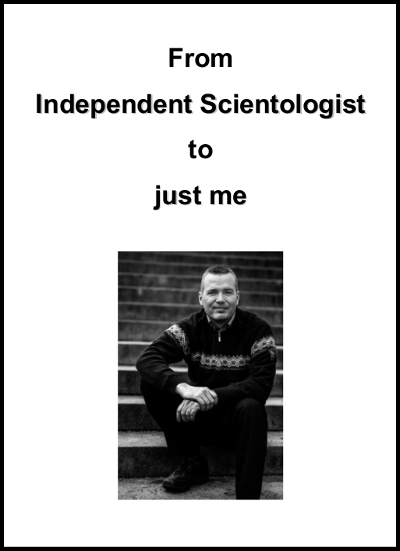
Book release: From Independent Scientologist to just me
Like I did with the book, “Six months in the open“, I have compiled a running record of all Scientology-related posts on this blog.
This new book shows my gradual changing views since I started this blog in June 2010.
The two books combined gives a unique insight into an OT8’s journey out of the Church of Scientology and into the realm of the Independent Scientologists (“Six months in the open”) and then the unraveling of a Scientology-conditioned mind resulting in a free mind (“From Independent Scientologist to just me”).
This book is the distillation of Scientology-related posts on this blog.
Get it at Scribd.com.
Or download it right here (291 pages, 5.4 MB).
As usual, it is free and available under a free license.
A rerun of an epic post by Jeff
This one deserves a rerun (link to original post by Jeff Hawkins)
Non-Scientologist: So, tell me about Scientology.
Scientologist: Well, it’s a religious philosophy which contains tools that anyone can use to improve their life. These are workable tools that have been proven to be uniformly successful if they are applied correctly.

Non-Scientologist: OK, but forgive me if I question your statement about being uniformly successful. I’ve seen some disturbing things online. Apparently the head of Scientology is a sociopath who is physically and verbally abusive to his staff, many staff are treated no better than slaves, the organizations put incredible pressure on their members to come up with more and more money, people are forced to disconnect from their families, the Scientology organizations are failing, emptying out, and there are a lot of defections, including top level OTs. There have even been OT suicides. That doesn’t seem to indicate uniform success.
Scientologist: Well, you have to understand that people running the Church are not correctly applying Scientology. They’ve altered the technology. What they are doing is not Scientology.
Non-Scientologist: I’m sorry, you’re saying that Scientology doesn’t apply Scientology?
Scientologist: No. the official Church doesn’t apply Scientology.
Non-Scientologist: I see. Well, if alteration of the technology is such a major problem, maybe Hubbard should have warned people about it. Maybe he should have written an issue alerting them to the dangers of altering the technology, and had every Scientologist read it at the beginning of every course. And maybe he should have set up a part of the organization as a sort of Quality Control to police this sort of thing.
Scientologist: Well, actually, he did those things.
Non-Scientologist: Oh. Well, then, why didn’t that work?
Scientologist: Well, that’s because people have misunderstoods. They can’t duplicate what they are reading. They even have something called Crashing Misunderstoods.

Non-Scientologist: I see. That sounds like a serious block. Maybe Hubbard should have written something warning people about the importance of understanding words. Maybe he should have developed a technology of how to study, and how to handle these “Crashing Misunderstoods.”
Scientologist: Well, actually, he did. It’s called Study Tech.
Non-Scientologist: OK. Well, why didn’t that work?
Scientologist: Well, people don’t apply it! They don’t clear their words. They’re out-ethics! They are just blinded by their own overts –transgressions – and they have withholds.
Non-Scientologist: Well, I can understand that could be a problem. Hubbard should have invented a technology of ethics to help people be more ethical and disciplined. And maybe he should have directed some of his counseling techniques to help people become more honest and ethical.
Scientologist: Well, actually, he did. There’s a whole book on Ethics and a lot of auditing procedures to address that.
Non-Scientologist: OK, well, why don’t people apply that?
Scientologist: It’s hard to get anything standard done in orgs these days! The Orgs are a mess! They are off-purpose, more interested in money than really helping people. They are understaffed and harassed and insolvent and desperate!
Non-Scientologist: Sure, I can see how that would be a problem. Well, maybe Hubbard should have developed a technology of organization; how to keep organizations on-purpose and functioning properly. Maybe he should have written up all of their duties in detail so they know exactly what they should be doing.
Scientologist: Well, actually, he did do that. It’s been published in ten big volumes.
Non-Scientologist: Well, then, why doesn’t that work?
Scientologist: Staff don’t have time to study it. There’s too few of them and they are desperate. They can’t make enough on staff so they have to moonlight. There are just not enough public in the orgs!
Non-Scientologist: Oh, I see. Well, then, maybe Hubbard should have developed a technology of how to promote and market Scientology. Maybe he should have provided drills telling people how to effectively disseminate Scientology.
Scientologist: Well, actually he did do that.
Non-Scientologist: Ok, why isn’t that used?
Scientologist: You don’t understand! Scientology has terrible PR. It’s hard to disseminate to people because Scientology is so disliked in society.
Non-Scientologist: That is definitely a problem! Maybe Hubbard should have developed a technology of Public Relations so staff could learn how to create a good public image and good relations with the public.
Scientologist: Well, actually, he did that.
Non-Scientologist: Then why is there a problem?
Scientologist: Nothing standard can get done in the Church! The whole of the Church of Scientology has been taken over by Suppressive Persons. They are perverting the tech! They are destroying the Church! Everyone is PTS to them!
Non-Scientologist: Goodness, that sounds serious! Well, maybe Hubbard should have developed a technology to show people how to spot Suppressive Persons, and how to handle them once you’ve spotted them, so you don’t go PTS.
Scientologist: Well, actually, he did that too.
Non-Scientologist: Oh! Well, then, why doesn’t that work?
Scientologist: There are so many other factors I haven’t even mentioned! These Suppressives overwhelm people! They use implant technology!
Non-Scientologist: Well, why didn’t Hubbard develop some advanced techniques to give people freedom from being overwhelmed and proof them up against the effects of these implants?
Scientologist: He did! He did! But you don’t understand! This is Planet Earth. It’s a crazy place! You can’t get technology correctly applied when you have people who are not rational, who are stupid, who are not sane, who are low on the Tone Scale, who are aberrated…
Non-Scientologist: Well, maybe Hubbard should have developed a technology to make people rational, sane and intelligent, to raise them on the Tone Scale, to get rid of aberration…
Oh wait. Isn’t that what Scientology is supposed to do?

Summary
OK, this is a fictional, contrived conversation. But how many of these explanations have you heard in real life? And how often have you seen this kind of circular logic?
In my opinion, the most basic of Scientology’s system flaws is that Scientologists are trained not to see system flaws. Even when failure is obvious to everyone else, fundamentalist Scientologists will refuse to inspect the system. They will interpret all failure as individual failure. They become experts in explaining away failure.
Doctrinaire Scientologists can neither see nor correct systemic flaws, and thus Scientology is incapable of correcting itself.
And maybe we’re getting closer to a real Why.
The perfect match: HP-41 and your telescope
Got a neat little program for you: SCOPE.
The abstract from the page:
“This program calculates values for telescopes and oculars. You start the program, add a telescope and then as many oculars as you want. You can then view several values for the telescope as well as the details for each ocular when used with this telescope. You can also save the data set (telescope and oculars) to an XM file or retrieve a file saved earlier. You may add new oculars as needed to a retrieved file and save it anew.”
Before you start jumping with joy, take it for a ride and tell me what you think. Miss anything in there? Want it to do some other things? Like make a cup of coffee for you? Just slip me a note and will see what I can do.

Å: The US tour

The itinerary is set. Brendan and myself will be visiting both New York and Los Angeles. Our purposes for the trip:
- Meet interesting people
- Inspire and be inspired
- Create opportunities for business
Many people responded to the previous blog post and several meetings have been booked. While many readers of my blog know me through my Scientology connection, we are looking to make this more of an “Å” tour than an “ex-Scientology”-tour. It would be great to meet people to see if we can create some interesting opportunities together. Anything fun. Anything out of the ordinary. We’d like to inspire some people on our trip. So, if you want some inspiration for free, or a chat over a coffee, there is still ample time slots available. We’d like to have a really busy tour.
We will be in NY Saturday 15th and Sunday 16th of June and in LA Tuesday 18th until Friday 21st.
Drop me an e-mail if you’d like to meet up – for whatever reason 🙂
 Geir Isene - uncut