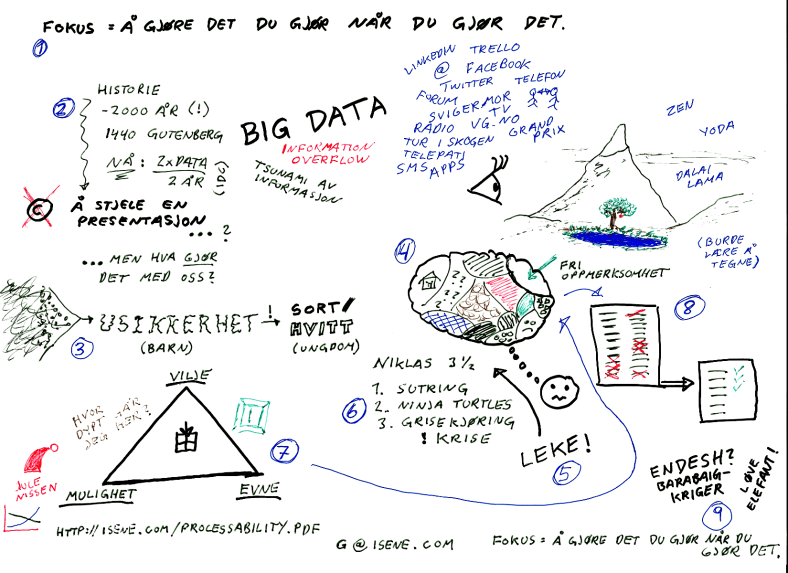
Hard Core to Soft Core

Just got around to write down more of our ideas (Brendan and myself) in a document titled “Hard Core to Soft Core”.

Here’s the abstract:

How do the soft assets of an organization relate to the hard assets? How does an organization change its culture? How does the structure of an organization relate to its people, products and processes?

These are but a few of the questions this article examines. It highlights the relationships between the various elements of an organization — from the hard core physical assets to the soft, intangible human elements.

Here’s the document: http://www.scribd.com/doc/94065549/Hard-Core-to-Soft-Core

ITIL – pragmatic and simple

As you may (or may not) know, I have been working professionally for many years with the IT organizational framework called ITIL (IT Infrastructure Library).

As mentioned before, my main focuses when helping my clients is:

  1. 100% responsibility
  2. Simplicity
  3. Immediate relevance

As ITIL can be seen as almost the opposite of the above, Brendan Martin and myself have been working hard to reduce ITIL to something simple, that is immediately relevant for an IT department or vendor, and that embodies the concept of 100% responsibility. Through numerous successful projects, we have now summarized our approach in a simple and straightforward document.

From the abstract:

“The IT Infrastructure Library (ITIL) is a best practice framework for service management . ITIL is a trademark owned by the Cabinet Office (part of HM Government). The framework was originally intended to serve the delivery of Information Technology within a company, but can also be used outside of IT and for delivery of services between companies. It could be argued that ITIL focuses on the implementation of processes to facilitate service management.

This article provides a pragmatic view of ITIL – a simpler and more straightforward implementation of some of the core ITIL processes.”

Get the article at Scribd.com or get the PDF directly from isene.com.

I have sent out the following message to several ITIL-related LinkedIn groups totaling more than 80000 members:

“Those who have been wrestling with the ITIL books may appreciate the simplicity presented in this article: http://www.scribd.com/doc/91495325/ITIL

I expect objections ranging from “It isn’t this simple” and “Organizations are too complex for this approach” to “You don’t implement ITIL, you implement Service Management” and possibly “You can’t give this away for free“. The ITIL professional communities tend to be rather elitist, self-protective of their revenue stream, closed-data-minded and complex.

But since I believe in simplicity and that information should be free, I decide to share this freely.

HyperList: Everything. Concise and precise.

HyperList is a methodology to describe anything in plain text.

HyperList can be used to describe any state or transition – anything from simple shopping and todo lists to large project plans, process design, the human history, the human DNA or the whole universe.

With HyperList, descriptions become simple, easily readable, concise and precise.

After a couple of months of work, and with a total overhaul, WOIM has been transformed into HyperList! I would like to extend my thanks to Marilyn Abrahamian for her invaluable help in proof reading and for suggesting some new, very useful features.

You will find the HyperList document on my newly redrawn home page (isene.com) or by clicking this direct link to the HyperList document. It is also available on Scribd.com.

I admit freely to being proud of this; I consider HyperList to be one of my most useful contributions so far.

For the users of the excellent text editor VIM, there is a plugin that makes it very easy to create and manage HyperLists in VIM. The plugin includes a large range of features such as:

  • Complete highlighting of HyperList elements
  • Collapsing and expanding of up to 15 levels in a list
  • Linking/referencing between elements (items) in a list
  • Easy navigation in lists, including jumping to references
  • “Presentation modes” where you can view only parts of lists and line-by-line
  • Creating and checking of checkboxes in a list, with or without date stamps
  • Encryption (and decryption) of whole lists or parts of lists
  • Auto-encryption of lists – making a list into an excellent password safe
  • HTML and LaTeX export of lists
  • … and many more features.

Enjoy 🙂

Understanding Miscavige

David Miscavige is the leader of the Church of Scientology. There is much effort spent demonizing, paint him pitch black and to point him out as the only reason why the church is in serious trouble. As far as I have seen, and I have read most of the pro and con sites on the Net, no one tries to actually understand Miscavige. So I will make an attempt to highlight a possible reason why he acts as he does.

Scientology promotes the states of Clear and OT. But no one has reached the state of Clear as originally defined by the church founder L. Ron Hubbard. And Scientology has yet to produce a stable OT.

As the leader of the Church of Scientology, Miscavige is charged with the responsibility of delivering good on these promised results. He is also charged with the responsibility of following to the letter and to the dot any and all scriptures by Hubbard. He is faced with the impossible task of ensuring a fixed process producing a fixed result.

Seeing that the results are not consistently produced (and far from it), he naturally gets frustrated. He enforces the process in order to fix the result. Seeing that the results are still not coming off the assembly line, he fixes the process further. And further. And further. All the while getting more and more frustrated. And it doesn’t take a genius to understand this frustration. Frustration leads to anger, to shouting, to slapping, to imprisoning the idiots who cannot get the process right. And he starts to enforce his own ways. Make up his own policies and rig his own processes. But alas, a fixed process still doesn’t produce a fixed result.

He probably never heard of Gödel or General Systems Theory. Had he only learned to empower people instead of the process. To assign responsibility and really help those people thrive, be creative and produce the result. But to do that, he would have to violate the sacred scriptures of Hubbard. To achieve a certain result, one needs a flexible process and flexible tools. One would need to bend or break the rules more often than one would think. Scientology is dealing in people, not the manufacturing of cars. The input (people) are uncertain, or even random – while the input to the car plant is rather set. That is why one can have a very rigid process producing cars while such a process will have the opposite effect when dealing with people as input. Witness the current state of the Church.

People (and Scientologists in particular) are prone to stigmatizing, painting the world black-and-white and swiftly calling people good (social) and evil (anti-social or Suppressive Persons). This is hardly an effort to truly understand one’s fellow man. Rather, it is mental laziness to toss stuff quickly into the white or the black bin.

I believe a situation to be more easily handled if one tries to understand it. And if the situation is a one man show, understanding the man would make it easier to handle the whole.
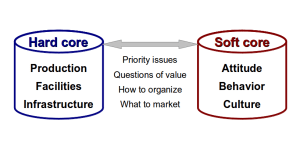

My talk on Big Data at the CiO Forum

Thanks to those who contributed ideas to my talk this Thursday. I held the opening talk at the CiO Forum here in Oslo. The forum is hosted by Computerworld and there was between 100 and 200 IT executives attending.

I was about to fall prey to my own preconceived idea that I should have a set of “traditional slides” (albeit with weird twists) as the basis for my talk. I should mention that I very seldom do slides. Mostly it’s me with a flip-over dancing and jumping and gesticulating like an Italian. I tend to use people from the audience up on stage to do small role-playing scenarios, to let the audience do drills and such. But this time I was about to simmer down to conservatism when Brendan thankfully shot my slides to pieces. As he kept on questioning my approach, I realized that I was on the wrong track.

Instead I decided to take a piece of paper and draw out the concepts I wanted to cover, and true to my own website, I ended up scanning the drawing and using that as the main point of my presentation. Funny when another speaker approached me before my talk, looked at this “slide” and asked: “Is that Powerpoint… or another fancy presentation program?” “It’s pen, paper, scanner”, I replied and he looked slightly confused.

I know that most of you here don’t read Norwegian. This is as good a time as any to learn the language. Any questions – just ask 🙂

Here’s the link to the full image.

Processes, automation and human potential (final cut)

After a solid overhaul, and with added concepts and information, the article “Processes, automation and human potential” is now published and available on Scribd.com. It is also available here.

From the abstract:

The following article attempts to illuminate some important aspects of business and organization, such as:

  • What can and should be automated?
  • When should you trust people rather than processes?
  • What is responsibility and how can you ensure the intended production?

This article tackles the basis for automation, processes and human potential for reaching goals.

For the readers interested in Scientology – this article incidentally explains why perhaps the main policy of Scientology, the “Keeping Scientology Working” spells the demise of the subject itself.

Definition of a “cult”

When a method becomes senior to a desired outcome, and when that method gathers a crowd.

I came to this definition as a result of my latest article on process vs. output. That article has been reworked and is ready for publication. Stay tuned.

Information overflow

What happens to us as we stand in a storm of information?

The information overflow is steadily increasing. We are bombarded by information from countless channels – newspapers, TV, radio, billboards, Facebook, Twitter, e-mail, sms, Linkedin, Google+, Diaspora, Trello, e-mail lists, forums, face to face conversations, phone, phone apps, blogs…

With such a massive amount of data, how do we cope? How do we sort? How do we sift? What to trust, and what to ditch?

On February 16th, I will be holding the opening speech at the CIO forum in Oslo. And with people like you reading my blog, I would be stupid not to ask for your views.

I am not simply looking for how you think we should handle massive data, but also what it does to an individual, to our society.

Gimme your take on the human aspect of the information overflow.

Update: My post after the talk.

multitasking