Midnight Magic

In 1987, we made radio history in Norway with the show “Midnight Magic“. It was the first role-playing program on the air and the only program that had a thriving black marked for recordings where certain programs were sold for as much as NOK 400 (USD 100 today). Stein Halvorsen and I had great fun running the program for 3 years.

The format was simple and effective: Each program had a certain theme and a specific goal to reach within a 10-minute play. An introduction was played at the start of the program to give the listeners the background to the evening show. This could range from rescuing a fair maiden from the clutches of an evil dragon to disarming a nuclear warhead before the city was blown to dust. Four players were picked out of the 100 or so calling in to participate. Each player got to pick a few items to help them on the quest. And then the adventure begun.

One of us (me or Stein) was the Game Master telling the participant what he or she saw while the other played each encounter along the way. They could meet the troll under the bridge, the goblin in the woods, the pireate on the ship, the alien in the hangar, etc. Spontaneous acting on the air.

Having released the complete Amar RPG, I thought my next project would be releasing all the recovered Midnight Magic recordings. But alas, SAJ has kept the Midnight Magic site going and I could sit back and relax, write this blog post and simply point to the great Midnight Magic archive.

Ah, the memories 🙂

The cover of the original Mega Role-Playing System (Fantasy Edition) released in the UK by Bent Brakas an me the same year as Midnight Magic started airing).

The cover of the original Mega Role-Playing System (Fantasy Edition) released in the UK by Bent Brakas an me the same year as Midnight Magic started airing.

Amar Role-Playing Game: Complete system online at d6gaming.org

Some have wondered what I have been up to the past few weeks. The answer is seen over at d6gaming.org.

It has been a massive undertaking to get the whole of the Amar RPG online – rule system, information on the Kingdom of Amar, world mythology and more.

amar

The whole system is now Open Source and put on a wiki so that anyone can pitch in to improve or add to the system or the world.

We welcome anyone to contribute new skills, spells, potions, rituals, magical items or any other neat and worthwhile additions.

And we welcome every nitpicking language enthusiast to correct errors in the text.

There is also a good collection of graphics included that any Game Master of any RPG system can freely use.

Go adventure!

Castle

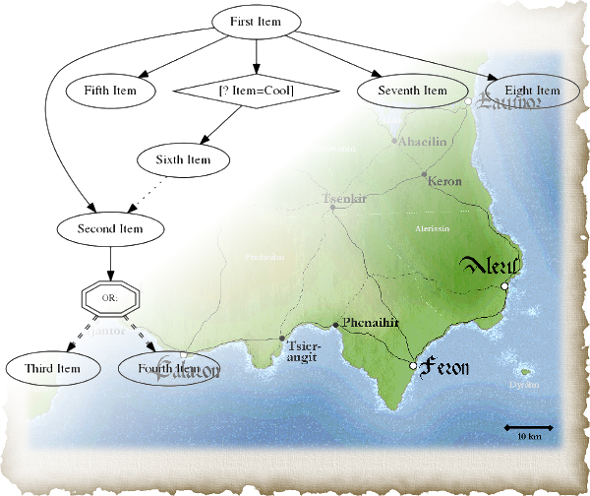
Graph your HyperLists online with HyperGraph

While I was at it, I decided to make HyperGraph available as an online service. With some wrestling with Ruby (the programming language) and obscure encoding issues, I got it up and running. Now you can take a shopping or todo list, a project plan or business process in form of a HyperList and get a graphical representation in a few seconds. I love when I get into my geek cave and work on stuff like this.

The domain isene.org is where I make my online services available (currently hosting the AMAR NPCg and HyperGraph).

index

My hunches and conclusions to Life, The Universe and Everything

In my quest to figure out existence, I felt it liberating to sum up my conclusions and hunches this far in the most concise form possible. Although none of my conclusions are permanent, they serve as stepping stones for further research. My hunches are mere pointers to research directions.

Question Hunch Conclusion
Is space and time discrete? Yes – and this is supported by what I consider to be the most promising cosmological theory to date, “Loop Quantum Gravity”.
What is gravity? It is the force mediated by the spin 2 boson “Graviton”. Einstein’s “space curvature” is in reality gravitons acting on matter and time.
What is dark matter? Gravitons have tiny mass and may even be self-interacting. This cater for the lacking gravitation pull needed to explain why galaxies can rotate faster than the visible matter would allow for.
What is dark energy? Dark energy is a name to describe why the universe seems to accelerate over time. This may be explained by the combination of vacuum energy with a graviton of non-zero mass.
Do black holes really exist? Perhaps, but without any singularity. Quantum laws such as the Pauli Exclusion Principle stops gravity from collapsing fermions into a singularity. An event horizon may still exist, though.
Will we ever devise a Theory of Everything? No. A ToE is described as “a hypothetical single, all-encompassing, coherent theoretical framework of physics that fully explains and links together all physical aspects of the universe”… which was proven impossible by Kurt Gödel and his Incompleteness Theorems.
Is the universe infinite? No. But there is no end to it – as long as consciousness creates more, there is more universe to be observed.
Is the universe real? No, it is created every discrete moment by consciousness. We see what we see because we create it. The universe is the sum of a massive co-creation of all consciousnesses involved.
Is there free will? Yes. Potential free will, when exercised is consciousness which in turn observe its own creations. Existence is not pre-determined or deterministic.
What happens when I die? I get a reboot – out of and into the game of life. I arrive back at a higher understanding and get to participate in the game of life with a different identity in a different body. Much like ending a computer game only to start another.
Higher level of understanding? Are there many such “levels”? It’s not “levels” per se, but rather many plateaus or layers like an onion. The movie “Matrix” is an excellent metaphor for my fractal view of existence.
Which world view is ultimately the correct one? All of them

… To be revised and revised and re…

hcg87_gmoss_960

Coaching and mental training – a summary of my approach

With the inspiration and help from Brendan Martin, I have written an article that sums up my approach as a coach and mental trainer. It could serve as the seed for an upcoming book that we write together on this topic.

I would like to thank the many hundred subjects that I have had the honor of helping – including the many young people that was struggling in life. A special thanks goes to Tiril Eckhoff who has been an excellent subject and effective measuring stick for what this approach can do.

The article is available as a free pdf (download or read on Scribd).

It is written as a primer to people I coach and as inspiration to those with a purpose of helping others.

Give more than you take

Today I was looking at what makes my life work well. The results I create come from the actions I do. My actions come from my decisions. And my decisions come from my attitudes, my values. So, I started looking at my values in life, and though they count dozens, there would be one central, major value that I can consider core. I came to this:

“Give more than you take”

I could add, “Take lots, but give even more”.

That sums it up for me.

Try this

Go to a random shopping mall, café or public place. Approach a random person and ask if you can buy him a cup of coffee and if he has an hour to spare. Tell the person you will invest the next hour trying to help him – in any way you can – with no strings attached. You will not need to know the person’s name or contact information. You ask nothing in return. Nothing at all.

If the person agrees, commence with helping the person during that one hour. Figure out something you can help him with and do whatever that will be of benefit. When the hour is up, you’re done.

If you have done a really good job, the person will ask if you can help him more. Then you say, “Yes I ca,n help you another hour – but only if you help 5 other people just like I have now helped you. Five people, one hour each. When you have done that, you can get back to me. Here’s my contact information.“.

If the person returns after helping five random people, give the person another hour of honest help. You will often find that the person will benefit more from helping others than you will be able to help him.

If you do this with at least a dozen people, I would very much like to hear how you did.

reaching_out

In the wake of the movie, “Going Clear”

Going Clear has created quite some commotion. In traditional media, social media and back channels. I have had my hands full answering emails and chat messages from journalists, ex and current scientologists and other people interested in Scientology. Never have I had such a wide range of discussions going on this subject – from those that saw the movie, put down the cans and walked right out in the middle of OT 7 to those considering rejoining. Yeah, the range is wide.

There wasn’t much new material for those that have been discussing this subjects actively on the Net. But it was well put together. The movie covers most of the important angles and subjects within Scientology. With a solid run through of its history and excellent highlights on the current problems in the church. What it didn’t really answer was why people get into Scientology and why they stay. What is so fascinating about this subject? There is really only one answer: Gains. People do have excellent gains from practicing Scientology. Jason Beghe is perhaps the only one in the movie that gets to express this underlying reason why people hang around in Scientology.

Going Clear

As I was watching the movie, I kept thinking about my first years in Scientology. The excitement, the fantastic gains I had from the communication drills, the atmosphere in our local church. Those were the happy days. As I flesh out in details in my book, “Nittenåttifire“, I went from shy to a radio show host within just a couple of years. From awkward to able to pick up girls. The gains was real and they were excellent.

The movie, and especially Jason, brought those memories, those years right back. And when I got scores of people asking the appropriate question after the film, “why did you stay for so long?”, I reiterated my gains. And when a few of them told me that they were considering rejoining the church, it left me thinking if I would consider ever going back.

Well, I wouldn’t. Not in the state the church is in today. But what if there was to be a change in the management of the church? What if Hubbard returned? What if the management system was revised? Would I then go back? Maybe.

If “Going Clear” incites a major change and Miscavige left the building, I would seriously consider rejoining the religion that has given me so much real and lasting gains. Not just to complete my OT levels, but for many other reasons, I hope that the movie affects the church in a positive way. Hubbard’s technology deserves it.

Update (2015-04-02): Now that the first of April has passed into the second of April, I can reveal that this was indeed my April Fool’s joke. I am not rejoining anything. Hubbard is not rumored to having returned and I have heard of no person considering going back to the cult. The one thing that is true in this blog post is this: It is a blunder of some magnitude that films like “Going Clear”, the book it is based on and just about any other film and book on the subject of Scientology fails to answer the one single question the audience always ask afterward, “Why the heck do people join Scientology and why on Earth do they stay?”

What to take responsibility for

When I coach people, the main positive step occurs when the person stops feeling responsible for what other people think or feel and starts taking responsibility for what he or she thinks and feels.

Taking full responsibility for one’s own thinking, feelings and actions is liberating. Further freedom comes from stopping the worrying about what others might think.

One creates one’s own thoughts and feelings. What one thinks and feels is a choice. Always – even when it doesn’t seem like it. To conquer one’s own thoughts and emotions is hard. But it is a worthwhile quest.

When I read this post to Anette, she asked if I should include some practical examples where this viewpoint would be benificial. Then she added, “…or maybe you should ask your readers for good examples?” And so I do.

thinking

In search for perfection (yeah, tech stuff)

Only a short while after having settled with dwb as my browser of choice, it was announced that it was unmaintained. Development had stopped and it was left in limbo. Again I was out hunting for The Browser. Revisiting Luakit and Uzbl, I discovered Vimb that seemed promising – but it had a few snags that ended up prolonging my quest. I hang around in the IRC chat channels of several tech projects, including a handful browsers. Got chatting with the main developer (“The Compiler”) of a new browser on the block just before X-mas – and it turned out that his qutebrowser served well as a Christmas present.

Qutebrowser uses a different underlying technology (QtWebKit), written in Python, has a very clean configuration, extensible and actively maintained.

It still lacks a few features like a form filler, session management and support for AdBlocks “easylist” (although it has a more rudimentary adblocker). But these are on the roadmap, and with the pace of development, I am sure these and many other neat features are not far away.

One thing that bugged me was how QtWebKit rendered fonts. Fonts were noticeably slimmer rendering web pages less readable. After some hours of tinkering, I solved the issue by first getting a better font setup for my system (here), then installing the Ubuntu package called “texlive-fonts-extra” and setting the font “Lato Heavy” for the following font settings in qutebrowser: “web-family-standard”, “web-family-serif”, “web-family-sans-serif”, “web-family-cursive” and “web-family-fantasy” (and the font “Droid Sans Mono” for “web-family-fixed”). Now fonts are beautiful and very readable.

After wading through more than a dozen browsers, qutebrowser fits the bill quite nicely.