What’s with the fuckin’ drama?

Ten years ago my youngest son was three and sitting besides me in the front of the car on his little baby-seat. I was 20 minutes late for an important presentation for 12 eagerly awaiting important people. My phone was dead and I couldn’t call in to say I was late. I was running 5 red lights in a row, teaching my son a few swear words in the process. When I got to the final intersection, there were three cars in front waiting… on a green light! The light was fuckin’ green and they weren’t moving. I was honking the horn and about to decide to freak out when my son looked at me calmly and said: “Daddy, this is no crisis”.

All my stress inflated like air from a balloon. My body and mind went instantly calm as I turned my head to him and said “You are absolutely right – this is no crisis.” I chilled, ran the car in second gear, whistled a tune, had fun with my kid, parked the car, walked jolly and unseriously into the meeting and completely rocked the room by relating my newfound knowledge. Delivered to me by my son no less. A lesson that has served me well ever since. I’ve told this story before, but it’s worth repeating.

Nowadays I look at the apparently serious and critical situations that seems to abound. When people write to me in fits over something, when business people tie themselves into a not over details, when everyday situations gets the better of stressed-out individuals. I curiously watch when this happens to me. And then I remember my son’s words and decides to instantly chill.

The drama is very seldom warranted. “This is no crisis”.

Tools

A tool is any aid to accomplish a task. From a hammer, drill, robot or car to a process, method, equation or your own mind. A plan, a preconceived idea or an expectation are also tools. As long as a toll remains under your control, you’re fine. But when the tools start running you, responsibility and control suffers. Let’s kick this off with the dictionary definition of “tool”:
tools

TOOL (Mirram Webster)

1 a : a handheld device that aids in accomplishing a task
b (1) : the cutting or shaping part in a machine or machine tool (2) : a machine for shaping metal : machine tool

2 a : something (as an instrument or apparatus) used in performing an operation or necessary in the practice of a vocation or profession [a scholar's books are his tools]
b : an element of a computer program (as a graphics application) that activates and controls a particular function [a drawing tool]
c : a means to an end [a book's cover can be a marketing tool]
d often vulgar : penis

3 : one that is used or manipulated by another

4 plural : natural ability [has all the tools to be a great pitcher]

Origin of TOOL: Middle English, from Old English "tōl"; akin to Old English "tawian" to prepare for use — more at "taw". First Known Use: before 12th century

Let’s focus on definitions 2a and 2c here.

I could go on and on explaining the usefulness or necessity of tools, the joy of my tools (HyperList, my HP calculators, my PC, my mind and my penis), or the troubles that ensue when your tools starts taking over. I could explain how troubles in life most often come about when your mind starts running the show, rather than you remaining in control (the essence of irrational behavior). I could point to the article “Processes, Automation and Human Potential“, and show that automation must remain under someone’s responsibility, lest it will bereft the user of will. Etc.

But for the sake of succinctness, I will leave you with a scale of “free will“:

  1. No Tools
  2. No tools needed
  3. Tools used freely
  4. Tools used compulsively
  5. Tools needed
  6. Automation
  7. Only tools

When you are in prison, you are at level 5 or 6 – the effect of tools (the prison system). When you are scared shitless of a spider on the floor, you are likewise at level 5 or 6 as your mind has taken over the control. When you use a calculator to figure out an answer, you are on level 2, 3, 4 or 5 depending on whether you could have gotten the answer without the calculator. When you use a slide show in a presentation… levels 2-5, unless you have no choice at all – as when your boss has ordered you to run those exact slides (then you would perhaps serve at level 6). When a process or method or ideology becomes more important than the result it aims to achieve, you operate at a level below 3.

In different areas of life and at different times, we are operating at different levels on this scale. Our need for tools depends on our inherent abilities, our confidence and our love of the tools we use.

Of course, tools are part of any game. To master a game, you must master the tools, and that implies being able to use the tools freely, if at all. When you are struggling in a game, you are struggling with the tools, you are unable to use them freely. And that includes your mind.

Personally, I am on a quest to nudge myself towards the top of the scale on most any area of life (except for my HP calculators). It seems to me that freedom is gained through regaining the ability to freely use the tools in a game, and by the subsequent shedding of the tools involved.

I get the ball, I pass the ball.

Perhaps the best midfielder in the world, Xavi, explains how he and Barcelona is so successful in the game of soccer: “I get the ball, I pass the ball. I get the ball, I pass the ball”.

I use his quote to make business people understand what 100% responsibility, simplicity and immediate relevance is all about. It is a simple enough statement, but it is only immediately relevant in business when you understand the meaning of the two operative words “get” and “pass”. Xavi didn’t say “I happen to get the ball, I get rid of the ball. The ball got to me, I kick it somewhere.”

Let’s take a look at the definitions of those words. From Mirriam Webster’s:

Get: To gain possession of, to seek out and obtain.

To “get” the ball means to seek out and obtain and gain possession of the ball. It is a causative action – the player takes 100% responsibility for the input – getting the ball under his control.

And for the sports definition of “pass”, we turn to Wiktionary:

Pass: The act of moving the ball or puck from one player to another.

To “pass” the ball is to take 100% responsibility for the output – that the ball passes from one’s own control to that of a teammate.

This is the essence of the article titled “Processes, automation and human potential“. It is a simple concept and very visible when it fails or succeeds in soccer. But oh so difficult to get people to understand and practice in the business world.

One doesn’t just sit around and wait for the input, one obtains the input needed to produce value in one’s job. One takes 100% responsibility for getting what one needs in order to deliver what is expected. And 100% responsibility means no blame, shame or regret – only that one gets the needed input.

And one doesn’t just pass off any package out of one’s area of responsibility. One ensures the customer really gets the value expected, or better. The customer is the recipient of the value one creates. whether internal or external to the company.

This is all about 100% responsibility. And it is simple – that’s why it works so well. And it is immediately relevant. Even in the family, among friends or in business.

Xavi really gets it, and he’s the best.

Trust

Holy crap! That can’t be possible! The car was heading for disaster at 170 km/h. The space between the two cars in front of us was surely not enough for this cab to squeeze through. Three lanes wide. Three cars driving at perhaps 80 km/h. And here we were coming up at more than twice their speed. I could be freaking out. Instead I reached for the safety belt. Slowly. I didn’t want to offend the taxi driver. I was part terrified, part determined to put on the safety belt unnoticed before I could brace for impact.

Woosh! Like a baby squeezed through a tiny opening at birth, with a few centimeters to spare at each side, and with the the driver whistling a funny tune while he turned around wondering if I said something to him. My lips had let out a tiny squeak, and he wondered if enjoyed the scenery. Scenery? What scenery. I was close to shitting my pants and he was looking at me and the mountains. Look at the fuckin’ road.

Now what?? Off the road? This time there was no space in between the car in front. So this bat shit taxi driver decides to pass on the outside of the road at 150. Gravel, sand and dust everywhere and again – woosh! We were back on the road. The only thing that indicated that this driver was not acting on his death wish was his relaxed and jolly whistling.

In between the death defying stunts I got around to ask him “How long have you been driving a cab?”. In Greek-English he revealed that he had been driving since 32 years and with only 1 or 2 weeks of vacation each year. And 7 days per week no less and some 14 hours each day. Sure to offend the guy, my lips formulated a rude question before I could swallow the words “Is this how you usually drive?”. “Sure” he answered unaffected in between the funny tunes.

I started calculating – 14 hours times 7 days equal 98 hours. Times 48 weeks or so becomes 4700, times 32 years is more than 150000 hours of driving like mad. And with less than two hours from Athens to Poros, my chance of dying on this trip is less than 1 over 75000. I am safe! The maths got to me and I immediately decided to relax and enjoy the ride like it would have been in an amusement park.

Then it dawned on me – this guy is displaying a degree of trust like I’ve never seen before. Not just in his own abilities as a driver but in all the other drivers on the road. From then on I was enjoying the scenery, the ride and the admiration of this cab drivers display of trust.

5000 reads on Scribd

I swung by Scribd.com and found that my articles now have a total of more than 5000 reads. That would account for around half the number of total reads of those articles (the rest being read on isene.com and elsewhere). If you haven’t yet looked at the articles, now is the time to nudge you to swing by the same place 😉

Writing articles: Collaboration

Writing articles in collaboration with great people

What culture does it foster?

ITIL is lacking in people-focus. PRINCE2 is lacking in creativity, LEAN is missing out on innovation, and Scientology management philosophy (LRH admin tech) is lacking in compassion.

Objection! ITIL talks about people, and that people are a core asset to any organization. PRINCE2 certainly inspires creative projects to be more successful. LEAN is stressing innovation through continual improvement. And L. Ron Hubbard covers the concept of affinity and also compassion in several places like the policy on “the model hat of an executive”.

All true. But a grape in an apple pie does not make it grape pie. And a mention of love does not make Anders Behring Breivik a loving person.

Because it is not what a subject happens to cover. It is what it predominantly covers. One has to look at the whole picture and see what the major portions are dealing with. The major parts of a subject marginalizes the parts that happens to be included. The intentions behind a subject is made evident by the major focuses of that subject. And that is the culture it fosters.

Scientology management philosophy fosters robotic and militant obedience to policy. LEAN fosters blinders and a squeezed organization, PRINCE2 fosters bureaucracy and ITIL fosters red tape through process compliance. None of them makes for an inspiring, creative and people-focused organization. Because even though these concepts are mentioned, they are dwarfed by the major parts that focus on hard and cold values of yestercentury.

It seems that most organizational frameworks are created as a substitute for more directly handling the problems of responsibility and communication between people.

This is not say that all such frameworks are useless. They may very well contain useful tools. But organizational frameworks will always be inferior to human attention, a warm heart and a hug.

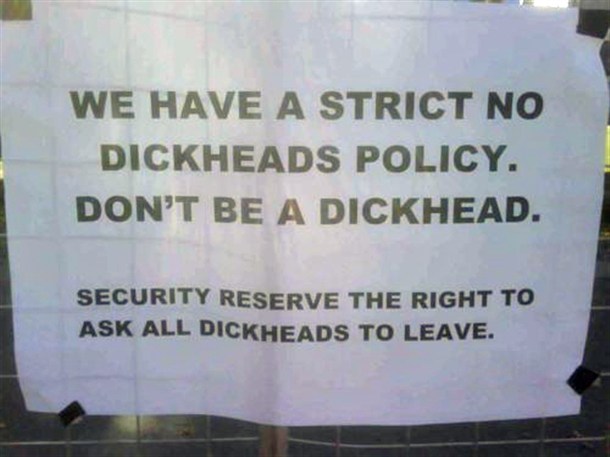
In the spirit of strict policy:

In the spirit of strict policy

The hunch and the key

I have a hunch. That the ultimate truth, the secrets of existence, the answers to Life, Universe and Everything is in fact in front of us. Right there, or here, hidden in plain view. For everyone to see and for everyone to understand. That there is perhaps no secret and that the understanding of it all is up for grabs for any and all.

My hunch is further that it would only require a certain attitude, a willingness or idea of what to look for or how to really see what is here, there and all around – the ultimate understanding of it all. I believe the X-factor, the key, the “it” is right there on the table in front of you and me – a metaphor for within our grasp at every moment. My quest is to find that key.

Free Will

Finally, after a couple of months of revamping, re-editing and polishing, the article “On Will” is published in version 2.0.

You will find it on Scribd.com as well as right here.

Read it. Comment on it. Share it freely.

Many changes in the article came about through inspiration from the contributors on this blog – such as marildi, Maria, Chris Thompson, 2ndxmr, Brendan, Valkov, Vinaire, Dennis, and many others. I value your input, so feel free to discuss the content or alternative views or give links and pointers to relevant data on free will.
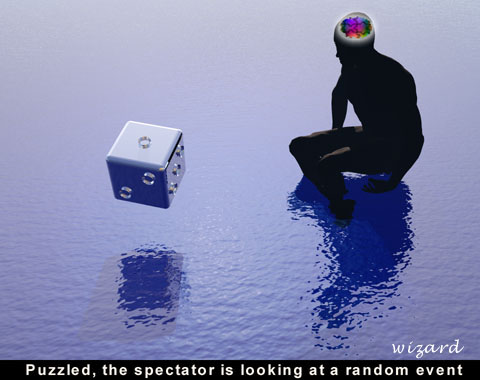
Here’s the start of the article:

On the subject of choice, there are two options: Either you really have a choice, or the appearance that you may choose is simply an illusion.

By choice is meant the possibility of will being exercised. Thus, the subject of choice is strongly related to the subject of free will. Do you really possess free will?

Since there are many situations where people seemingly cannot choose what they want, we will refer to free will as meaning potential free will.

You either have potential free will or no free will. In the latter case, it should not even be called will as everything is then simply a series of events with no will involved.

Let us explore the possibility of no free will: You have no choices; it is all predetermined. Everything is simply a series of events. There is no will involved and everything is determined by the laws of the physical universe. This assertion we label a Physical Theory or an Objective Theory.

Determinism is a common view among natural scientists and is gaining ground in the general population. In the book A Brief History of Time the astrophysicist Steven Hawking explains it very well: If you know the state of the universe at any given time and all the laws that govern it, you can calculate all consecutive events. You can determine every single motion in the universe at any time. The brilliant French scientist Pierre-Simon Laplace formulated this idea in a paper published in 1814 (eng. 1902): Although it has been proven that such a thought experiment is impossible, that proof still does not disprove the universe as causally deterministic.

Many physicists disagree with Laplace in that they assert the possibility of randomness in the universe. Random events would break the prospect of calculating the future. However, such being the case still wouldn’t necessarily leave room for any will or real choices.

We see that there are two Objective Theories: the Deterministic Model and the model that allows for random events, the Random Model.

The Objective Theories are attractive in that they present complete systems within the boundaries of the physical universe without any external influence. The beauty of such a system lies in what it can prove — anything physical can be proven in and by the physical universe.

The Objective Theories also make the science of physics the ultimate profound science able to explain it all.

In the Objective Theories, there is no will that can cause anything. Everything is an effect of an earlier effect or is simply a random event. With no will there is never any purpose behind why something happens.

If the worldview of no free will is the truth, it has ramifications into most fields of human endeavor. It most obviously disrupts the field of religion as religions in the main build on the notion of free will and the possibility of choices. But it also disturbs the fields of philosophy, ethics and law. With the removal of the concept of will comes the subtraction of responsibility.

Aristotle outlined the essence of responsibility — a definition that remains the basis for accountability in our judicial systems:

“Aristotle’s discussion is devoted to spelling out the conditions under which it is appropriate to hold a moral agent blameworthy or praiseworthy for some particular action or trait. His general proposal is that one is an apt candidate for praise or blame if and only if the action and/or disposition is voluntary. According to Aristotle, a voluntary action or trait has two distinctive features. First, there is a control condition: the action or trait must have its origin in the agent. That is, it must be up to the agent whether to perform that action or possess the trait — it cannot be compelled externally. Second, Aristotle proposes an epistemic condition: the agent must be aware of what it is she is doing or bringing about.”

There is no accountability for actions if there is no will behind them. There is no one to be held responsible if the person had no choice. Thus, the human systems of law and order are merely illusions — as is the apparent drive for happiness or attaining one’s goals. All such pursuits are appearances that are bound to happen or that happen by chance. The appearance of choice is an illusion. There is no reason for living.

The nullification of responsibility may seem glum to some and a relief to others. But it hardly matters as it either seems that way due to chance, or it was bound to happen.

There is no wrongness or rightness in the Objective Theories. There is only isness.

In the Objective Theories, there is no real difference between a human, an animal and a well-crafted robot. Artificial intelligence is within reach.

The physical universe is composed of space, energy, matter and time. Everything within it is governed by its laws, whether the laws allow for random events or not. Therefore, in order for free will to exist, it cannot be governed by the laws of the physical universe.

The power of choice must at least in part be separate from the physical universe in some way. And only if it can potentially be completely separate can it potentially be fully free. Free implies free from space, energy, matter and time. It does not suggest that free will is somehow physically located outside the universe as that would still subject the will to physical laws and hence it would not be free.

Read the rest of the article.