Today I simply want to point you to Brendan’s blog. He’s back 🙂
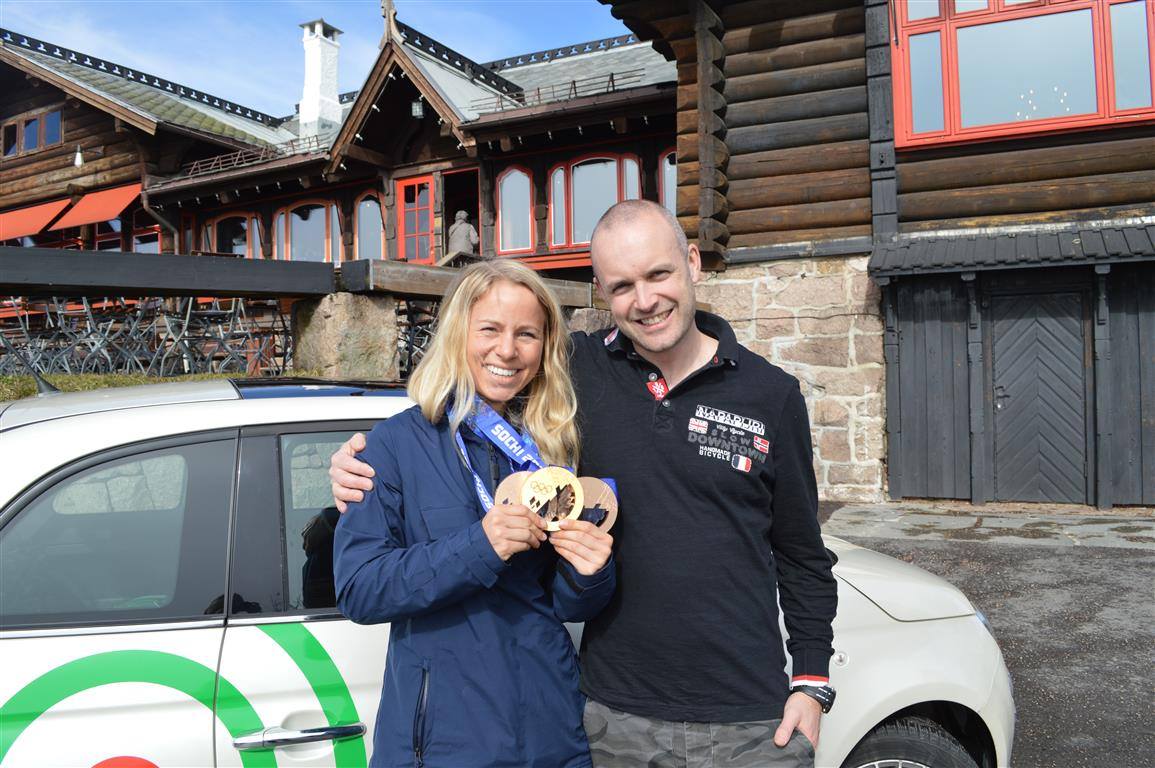
Brendan and Tiril – both amazing people.
Today I simply want to point you to Brendan’s blog. He’s back 🙂
Brendan and Tiril – both amazing people.
Do we settle for “just good enough” and “meeting expectations”? Or do we outperform ourselves and amaze the customer?
There are indeed rational arguments why we should merely meet the customer’s expectations and not go the extra mile. It is more costly to give awesome service. It puts an unnecessary pressure on the service delivery organization.
And while advocates of such rationale keep praising mediocrity, the amazing suppliers keep impressing customers and gaining market share.
Delivery contacts or Service Level Agreements should represent a worst case scenario, while the supplier should always strive for better, faster, more amazing. Or someone else will.
And if it seems too hard to keep up with the spoiled customer’s ever increasing expectations, then it is better to talk to the customer about this than forcing them to become less spoiled by delivering mediocre service.
Aim for “just enough” and you’ll miss half the time. Aim for amazing and you may just reach it.
Been busy lately. With moving into our new home, with interesting new projects, with coaching some amazing people. And so it has been quiet here on the blog. But I’ve got a new idea – what about writing a short blog post every day? Unfiltered thoughts, relating my everyday experiences or whatever pops to my mind. I will try it and see what happens.

The view from our new place – great for my telescope 🙂
Brendan suggested I read the book “Antifragile“. A life-changer. What’s the opposite of “fragile”? Most people replies “robust” or some synonym. But no, that’s not the opposite of “fragile”. If you think of a scale from -1 (fragile) to +1, the “robust would be zero. On the minus side of the scale we find the stuff that is harmed by shock or sudden change – like a fragile vase accelerating toward the floor. Stuff that are not harmed are in the middel of the scale, while stuff that benefit from shock or sudden change is on the plus side. While the story of Hercules beheading Hydra only to see two heads replace the former head neatly illustrated the plus side, there are more common-day examples. Like your body. Exercising your body breaks down muscle fibre resulting in a better body. Stuff that adapts, adopts, learn from getting hurt are “antifragile”. And that is far above something “robust”. And people can be fragile. Or robust. Or antifragile. I aim for the latter and have been for a few years.
It actually got me thinking about how I could benefit from the ultimate harm. Got me thinking about death. And I find myself not fearing death. Rather, I am intrigued by it. I really wonder what it will bring. I’m almost excited about that change, whenever it will come. A friend of mine, Egil Möller once said that he believed the purpose of life was to come to peace with death. Interesting.
Apart from my recent personal philosophical explorations, I have been doing some interesting projects in Å. Currently, I am involved in a few projects at Bærum Kommune (one of Norway’s major municipalities) where I am facilitating a cultural change toward 100% responsibility and focus on Deliverables rather than Tasks (ref. my article “Processes, Automation and Human Potential“). I have also been writing their IT strategy for the next 6 years and proposing a steering and financial model. I also concluded a three month project with Altinn (Norway’s governmental digital data hub) last week. Apparently I moved some people in that organization – one person started crying as he stood up during the dinner to thank me for the project. He’s a great guy and I think he finally understood what a great guy he is.
On the coaching side, I have been working with a dozen people simultaneously for a few months with several concluding during the past weeks. One guy, a 16-year old was suicidal when we first met half a year ago. We established a scale from -3 to +3, reporting every day how the day was. A score of -3 would be “I want to kill myself”, a -2 would be a really bad day, -1 a shitty day, zero would be a “who cares”-day, a +1 equals a good day, a +2 a really good day and a +3 would be a spectacular day. We quickly got up from -3/-2 to an average of -0.5. Now he is regularly reporting +2 and very seldom as low as zero. So, it can be done.
Also, Anette and I met with Dan Koon yesterday. That was fun. Dan is an amazing person. I am hoping to do some fun stuff with him in the near future.
I will probably write shorter posts than this on a daily basis. While on vacation during the next few days, I will write short posts from my mobile phone. Wonder how that will turn out. Up into the mountain we go – stay tuned for pictures 🙂

It’s not because she aced it in the Olympics with one gold and two bronze medals and came from nowhere to be one of only three Norwegians who got three medals in Sochi. It is because of the qualities behind that, and the qualities that aren’t even reflected in her performance as a top athlete.
I knew she was capable of getting an Olympic medal. Last summer, during one of our coaching sessions, I started out “When you get a medal in the Olympics…”, she interrupted “Eh… my ambition is to get into the top 10”. I continued “When you get a medal in the Olympics…”, preparing her for what to come. To me she was obviously amazing.
Tiril Echoff is mentally much stronger than even Tiril herself thinks. But above all, she is smart. Not just intelligent, but acutely aware, able to adopt simple ideas to concrete results. Adding that she is studying engineering at the Norwegian Institute of Technology – although taking a break from her studies to bring a few trophies back home.
I asked her the simple question that so many top athletes struggle to answer, “What makes you so damn good at what you do?”. “I am smart”, she answered. She wasn’t in any way haughty or arrogant, just very honest. And she continued, “I am not the one to train the most, but I train smart – listening to my body, relaxing when I need to and doing my utmost when I can”. And she is honest about what helps her in life. Going through some rough spots has made her smarter and able to appreciate her top results even more. Tiril is very quick to learn – both from her mistakes and from her successes.
Even above all this, Tiril is a down-to-Earth and very empathetic girl. She’s light at heart and funny. And able to not give a fuck when it really matters.
“I spent hours meticulously drawing an old castle, three levels of floor plans and carefully populating every room with Orcs, Trolls, Undeads and treasure. But even more hours was invested in planning how the players would approach the castle with their Role-Playing characters. The front doors would be unlocked and the characters would discover that, sneak inside, engage in a small fight with two filthy Orcs playing dice instead of guarding the castle, commence to the guard room, find a treasure, get surprised by a lutenant Orc walking into the room, etc. The plan was a masterpiece, but upon reaching the castle, I was taken completely off guard. They walked around to the back side, got out a grappling hook and climbed in through a small kitchen window on the second floor and… completely wrecked my plan! Dang! I hated unpredictable players.”

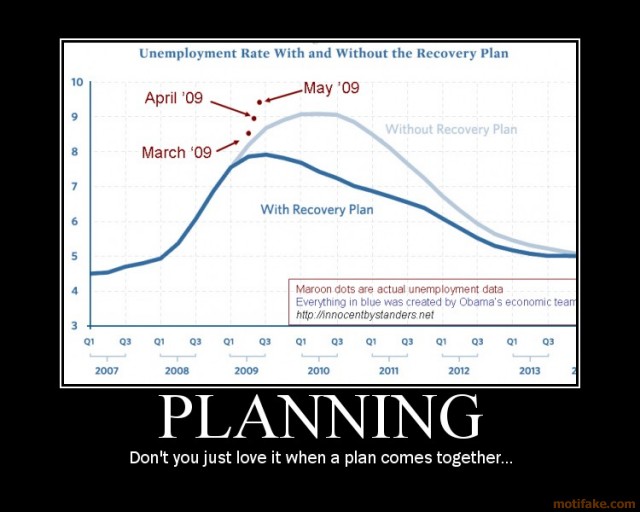
The purpose of planning is to increase predictability. Regardless of the name and the scope – strategy, plan, tactic, game-plan – the purpose is to avoid unpredictability. With the knowledge of Now, one seeks to make decisions into the future. The aim is to focus effort and to limit dispersement.
Sounds all good, perhaps. But there is a flip-side to this coin. When one focuses, one also limits and excludes.

In opting for predictability, you trade in intelligence, creativity and agility. By limiting future choices, you limit improvisation and potential genius. This is why most creative geniuses prefer not to work in large corporations or set structures, but rather in lean and mean startups or prefer to work on their own.
What you gain in focus and stability and predictability in the short run, you lose in attainment of long-term valuable skills.
To quote Ole Wiik, “one must practice what one wants to be good at”. As you focus your training in one area, you become less adept in other areas. Planning makes you better at planning. But it makes you less adept at improvising. By avoiding the unpredictable, you will never get good at tackling the unpredictable. Your mental dexterity will suffer proportionately with your increasing planning skills.
Another factor to consider is that decisions are always sharpest with the best and up-to-date data readily at hand. Thus, any decision made by planning, decisions into the future can never be potentially as good as a decision made in the Here and Now with fresh data and input. Limiting mental dexterity by planning and adding some blinders will make you less sharp mentally. Planning adds preferences, it adds filter that makes fresh input looks dimmer while you become dumber. In an interview with Chess.com, Magnus Carlsen said: “Having preferences means having weaknesses.”

Planning is a tool, a crutch. It enforces a view of the future based on today’s data. It stimulates preconceived ideas, adds a filter for new data, tend to help you avoid unpredictability and helps you never get good at tackling surprises. Tools and crutches are needed if you cannot cope with a situation without them. But right there it should make the alarm bells go off. Instead of getting addicted to the tool of planning, how about starting to practice tackling the unpredictable? Scary shit. I know. But it does add spice to life and skills to you.

Every year the organization “Operasjon Dagsverk” (eng. Operation Day’s Work) arranges for students in junior high and highschools to contribute one day’s work to a charity cause.
The students takes responsibility for finding a place to work for a day. The company that accepts the student pays NOK 300 to that year’s charity and puts the student to work. This year the money goes to an educational project in Guatemala. The day was this Thursday (31st October).
My oldest son, Niklas (14) asked if he and two friends could work at Å (a-circle.no). Obviously I took the opportunity. I got the idea of charging them with the task of creating two generic business models – one for Project Management and one for IT Service Management.
The boys got to work and in less than two hours, they delivered an intriguingly simple model for Project Management. Their “SUKK”-model pinpoints responsibilities in a project far better than the ruling model of PRINCE2.

Their model for IT Service Management was even more succinct and with excellent focus on exact responsibilities. While ITIL is perhaps the best professional model for corroding responsibility in an IT organization, their SAO model goes straight for the kill with no wishy-washy or overlapping responsibilities.
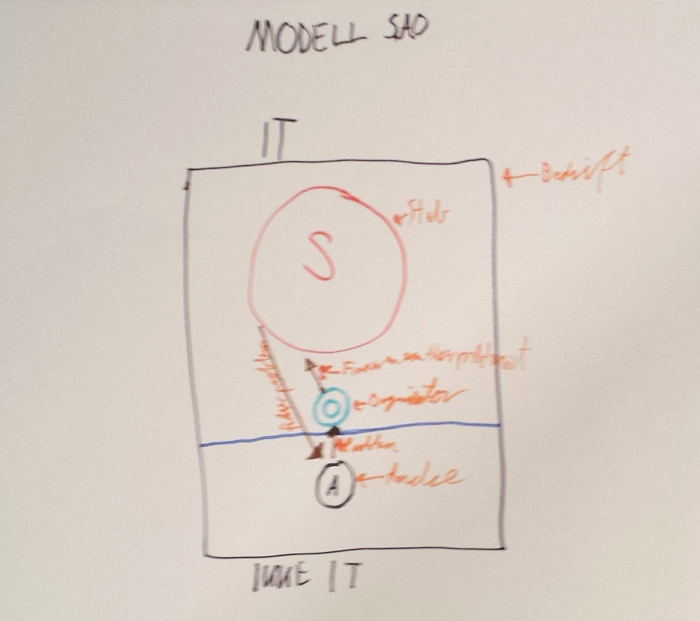
In addition to this, I got them to define the term “delivery” and had them write down exact deliveries for roles such as “a baker”, “a teacher”, “a student”, “a Prime Minister” and “an architect” as well as writing down their own personal deliveries in life. I have done this exercise many times with groups of executives and experts from businesses and government agencies. These boys were amazing and I believe they did a better and more efficient job than any other group I’ve seen.
The NOK 900 generated amazing value as I will use the results from this day in many seminars and talks to come.
Thanks to Niklas, Isak and Alf-Johan.
I have gotten many requests to post more about what I do when I help people as a coach and mental trainer.
The toolbox is large and contains a vast array of methods to help others depending on what they want to achieve. But above all, I hold the attitude that the other person’s interest, desires and goals are more important than any tool or method. I practice winging it more than anything else.
But there is one tool that I often use to help a person get back on his feet. It is a method I have found very effective when dealing with everything from a person coping or struggling to those who consider taking their own lives. This has nothing to do with introspection or therapy – I leave that to others. It has everything to do with getting shit done.
Here’s the simple way you can help another (or yourself):

You do this, and you will have a friend for life. And your friend will have a different life. This happens to be the tool I use that has the most profound effect on a person who is struggling in life.
Try it. Let me know how it goes.
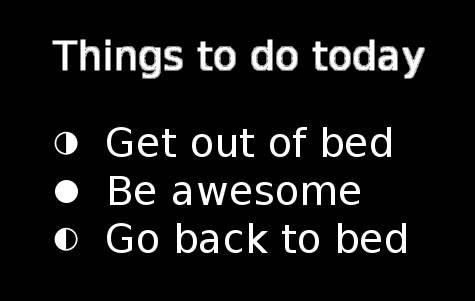
You either learn something new or complete something old. That is the hallmark of a successful day.
An amazing person that stands out as one of the most energetic, creative and bold people I’ve ever met. David Melchior is an IT manager at the Norwegian Meteorological Institute. He was the original inspiration for the article “Processes, Automation and Human Potential“. The above quote was but one of the gems that popped up during our meeting today. But that alone made it a successful day, as I learned something new.
I came up with this idea of using hashtags in my résumé or CV (Curriculum Vitae).

I also toyed with making the whole thing into a HyperList, but that would probably be taking it too far.
It would be interesting to get my readers take on this – both the use of hashtags, the layout and the content.
Get my hashtag CV here (pdf).
Update: Reworked the CV using LaTeX for better typesetting and to more easily work with it in VIM (bliss :-))
 Geir Isene - uncut