The hunch and the key

I have a hunch. That the ultimate truth, the secrets of existence, the answers to Life, Universe and Everything is in fact in front of us. Right there, or here, hidden in plain view. For everyone to see and for everyone to understand. That there is perhaps no secret and that the understanding of it all is up for grabs for any and all.

My hunch is further that it would only require a certain attitude, a willingness or idea of what to look for or how to really see what is here, there and all around – the ultimate understanding of it all. I believe the X-factor, the key, the “it” is right there on the table in front of you and me – a metaphor for within our grasp at every moment. My quest is to find that key.

Got something to say?

I am grateful and humbled by the many intelligent and resourceful people following my blog. I have learned much from widely diverging viewpoints and deep discussion since this blog was born two years ago. Thousands of readers and 20000 comments later, I would like to expand the blog to include blog posts by others – by “guest writers”.

A few months ago, I decided to let the comments on this blog flow unmoderated. I have also published a few times the writings of others. Now I would like to officially invite you to write on my blog.

Maybe you have something on your mind or in your heart that deserves an audience? Maybe putting up a blog is to much fuzz or to much of a commitment. Then you may get an opportunity right here to have your say.

I am open for any suggestion – anything from philosophy to food recipes to fictional stories or puzzles or, or, or. I can’t promise that I will publish it, but I will consider anything seriously.

Simply drop me an e-mail at g@isene.com

Are you game?

Maurice C. Escher – my favourite artist

Wing it!

A good friend and a remarkable person, Ole Wiik, told me his motto earlier this year:

“Practice what you want to get good at.”

I used to be terrible at talking in front of another person, let alone a crowd of people. Through the communication training in Scientology, I managed to get to the point where I was a successful radio show host. But I didn’t want to stop there. Even though the radio show made history in Norway, I wanted to also get good as a public speaker. I went to several of Mark Shreffler’s seminars and saw what a really good public speaker could be like.

But it wasn’t until I actually started doing it, training on it every week that I started to get a hang of it. In the recruitment company I ran in the 90’s, we decided I would give a seminar on how to hire people once per week.

Early on I decided to not use any aids. No slides. No script. No notes. This was a very conscious decision. I wanted to be able to speak straight off the cuff. Totally improvised – in order to tailor the message to the needs of the audience. That way I never had to worry about a computer crash, loosing the script or notes, or that the audience wanting something other than what I had prepared.

Lack of preparation was the key. Winging it. First with a lot of personal uncertainty. Like Bambi on the ice. I screwed up, made a fool out of myself. Sometimes mumbling, more often cracking a bad joke. Loosing my train of thought trying to weave a thread with no yarn.

Slowly but surely it started to pay off. The jokes got better, my focus went from how I was doing to what value the audience got, and the audience started recommending the weekly seminars.

After a couple of years I felt I could do this in my sleep. Time for new challenges. I started saying “Yes!” to any invitation to talk in front of people. Seminars on other subjects like astrophysics, communication, leadership, sex, IT and whatever else people wanted me to speak about, talks at weddings, toastmaster, etc. Throwing myself in at the deep end. Much like when I was 10 and my younger friend got me travelling a lift for 13 hours to rid me of my fear of elevators.

It culminated a few years ago when I was invited to hold a talk to some 300 students at a university. I decided not to have clue about what I would say until I walked onto the stage. I ended up doing a workshop on how to pick up girls, or boys.

It doesn’t matter what you want to get good at. Training is the key.

When people ask me what to do to become a blogger or writer, I simply tell them to start. By just doing it, winging it, you will get better at it. How good you will become boils down to your desire to get good and your willingness to learn and change along the way.

While this blog post is meant for a friend staying at home with a quarrelsome stomach, I hope it can inspire others to get going in a direction they want to master.

Kooks Unite!

When I got into Scientology back in 1984, I was a nerd. I couldn’t pick up a girl if my life depended on it. And while my interest in Scientology was initially along the lines of particle physics, it was the communication training that would give me a boost in the right direction.

During my first few months in the Scientology organization in Oslo, I noticed that quite a few of the people frequenting there was “a bit off” – not ordinary or normal. Some were right out wirdoes. Like me I guess, so I didn’t pay much attention to it. The training went great. There was a few strange situations, like grown ups yelling at eachother and behaving like they never had a real upbringing… but these situations were dwarved by my gains from the subject.

As time went on, I had more strange and even crazy experiences. One time the Executive Director started spitting in my face. Another time I was yelled at from point blank distance and with full force by the Depyty Commanding Officer for Europe. And I saw others being treated badly. But again, the gain kept mounting and the “score card” kept going in the positive direction.

In 1996 I was asked by OSA (Office of Special Affairs – the Church of Scientology intelligence arm) to help them out on the Internet. I was to do research and find information on the main enemies of Scientology and report back to OSA. It was like entering the loony bin. The news group alt.religion.scientology was arift with kooks. The place would give any psychitrist a field day. The fact that the kookiest of them all, Koos Nolst Trenite, had gotten the Kook of the Month Award in 1995 seemed to fit all to well into the picture. But the picture was clearly “explained” as this snake pit was the result of Suppressive People gathering to destroy my religion. It never really dawned on me that many of the kooks hanging out at ARS had been in Scientology and that many of the weirdities I saw inside the church could well have been equally kooky had they had the freedom to post freely and anonymously on the Net.

It also never occured to me how it was that the group with supposedly the best communication training in the world could get itself into such a communication mess as I saw on the Net and also in their handeling of media exposure.

As the pressure from Scientology International Management mounted parallelling the contraction of Scientology worldwide, the kookness became ever more present. All the while I was busy justifying that the craziness I saw in Oslo and Copenhagen had to be the lack of training in these lower organizations.

My severe reality adjustment came as I met the Church leader, David Miscavige in 2006. The insanity came from the very top.

I left the church in 2009 and have been posting and discussing Scientology on various forums, mailing lists and other channels since then – like my blogs, the FreeZone and IVY mailing lists, The ESMB and Anon forums, etc. I have also been active in very different arenas such as the EFN (the Norwegian EFF counterpart), the HP calculator Forum, various LinkedIn groups and Facebook groups, etc. When I compare all these arenas with those concerning Scientology (outside or inside the church) there seems to be an overrepresentation of kooks in the world of Scientology. While I remain among the few weird people in those other arenas, I am certainly not in a minority in the Scientology arenas.

But beyond the positive quirks or cute eccentricities, what I am targetting here is the inability to treat others with respect, the inability to resolve situations with good communication.

So, why is this? Is it because weirdoes get attracted to Scientology, or is it because Scientology produce them? In any case, it seems unlikely that Scientology is able to mitigate the kookiness among its ranks. And that puzzles me.

Let an open discussion ensue. No rules. No suspensions. Feel free to pitch in. Al, Dio, Vin, ESMB-ers and normal people alike, let your voice be heard.

Free Will

Finally, after a couple of months of revamping, re-editing and polishing, the article “On Will” is published in version 2.0.

You will find it on Scribd.com as well as right here.

Read it. Comment on it. Share it freely.

Many changes in the article came about through inspiration from the contributors on this blog – such as marildi, Maria, Chris Thompson, 2ndxmr, Brendan, Valkov, Vinaire, Dennis, and many others. I value your input, so feel free to discuss the content or alternative views or give links and pointers to relevant data on free will.
Here’s the start of the article:

On the subject of choice, there are two options: Either you really have a choice, or the appearance that you may choose is simply an illusion.

By choice is meant the possibility of will being exercised. Thus, the subject of choice is strongly related to the subject of free will. Do you really possess free will?

Since there are many situations where people seemingly cannot choose what they want, we will refer to free will as meaning potential free will.

You either have potential free will or no free will. In the latter case, it should not even be called will as everything is then simply a series of events with no will involved.

Let us explore the possibility of no free will: You have no choices; it is all predetermined. Everything is simply a series of events. There is no will involved and everything is determined by the laws of the physical universe. This assertion we label a Physical Theory or an Objective Theory.

Determinism is a common view among natural scientists and is gaining ground in the general population. In the book A Brief History of Time the astrophysicist Steven Hawking explains it very well: If you know the state of the universe at any given time and all the laws that govern it, you can calculate all consecutive events. You can determine every single motion in the universe at any time. The brilliant French scientist Pierre-Simon Laplace formulated this idea in a paper published in 1814 (eng. 1902): Although it has been proven that such a thought experiment is impossible, that proof still does not disprove the universe as causally deterministic.

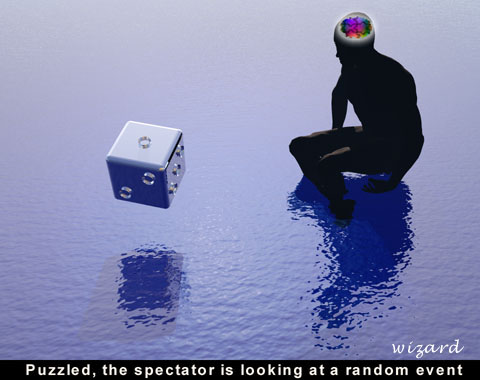
Many physicists disagree with Laplace in that they assert the possibility of randomness in the universe. Random events would break the prospect of calculating the future. However, such being the case still wouldn’t necessarily leave room for any will or real choices.

We see that there are two Objective Theories: the Deterministic Model and the model that allows for random events, the Random Model.

The Objective Theories are attractive in that they present complete systems within the boundaries of the physical universe without any external influence. The beauty of such a system lies in what it can prove — anything physical can be proven in and by the physical universe.

The Objective Theories also make the science of physics the ultimate profound science able to explain it all.

In the Objective Theories, there is no will that can cause anything. Everything is an effect of an earlier effect or is simply a random event. With no will there is never any purpose behind why something happens.

If the worldview of no free will is the truth, it has ramifications into most fields of human endeavor. It most obviously disrupts the field of religion as religions in the main build on the notion of free will and the possibility of choices. But it also disturbs the fields of philosophy, ethics and law. With the removal of the concept of will comes the subtraction of responsibility.

Aristotle outlined the essence of responsibility — a definition that remains the basis for accountability in our judicial systems:

“Aristotle’s discussion is devoted to spelling out the conditions under which it is appropriate to hold a moral agent blameworthy or praiseworthy for some particular action or trait. His general proposal is that one is an apt candidate for praise or blame if and only if the action and/or disposition is voluntary. According to Aristotle, a voluntary action or trait has two distinctive features. First, there is a control condition: the action or trait must have its origin in the agent. That is, it must be up to the agent whether to perform that action or possess the trait — it cannot be compelled externally. Second, Aristotle proposes an epistemic condition: the agent must be aware of what it is she is doing or bringing about.”

There is no accountability for actions if there is no will behind them. There is no one to be held responsible if the person had no choice. Thus, the human systems of law and order are merely illusions — as is the apparent drive for happiness or attaining one’s goals. All such pursuits are appearances that are bound to happen or that happen by chance. The appearance of choice is an illusion. There is no reason for living.

The nullification of responsibility may seem glum to some and a relief to others. But it hardly matters as it either seems that way due to chance, or it was bound to happen.

There is no wrongness or rightness in the Objective Theories. There is only isness.

In the Objective Theories, there is no real difference between a human, an animal and a well-crafted robot. Artificial intelligence is within reach.

The physical universe is composed of space, energy, matter and time. Everything within it is governed by its laws, whether the laws allow for random events or not. Therefore, in order for free will to exist, it cannot be governed by the laws of the physical universe.

The power of choice must at least in part be separate from the physical universe in some way. And only if it can potentially be completely separate can it potentially be fully free. Free implies free from space, energy, matter and time. It does not suggest that free will is somehow physically located outside the universe as that would still subject the will to physical laws and hence it would not be free.

Read the rest of the article.

My current stance on Scientology

With recent events cencerning the subject and the church of Scientology, it seems appropriate to reflect on my current stance on both the suvject and the church.

Debbie Cook left the church. Katie broke up with Tom. And now the news that the one and only Mark Schreffler declared independence as a scientologist.These are but three of the many blows that the church of Scientology has suffered in 2012.

As you may know, I left the church in 2009 with a 6 page write-up on why I had had enough. Since then I have been exploring life along many avenues. This and my previous blog give a decent picture of my explorations. I even published a book titled “Six months in the open” to give some kind of insight into one person leaving at the top of the Bridge. When I wrote a blog post titeled, “I am not a Scientologist”, I got many reactions, even got de-linked on Marty’s blog. Some thought “Oh, finally, Geir has seen the light”. Others thought I had gone bonkers. But most people understood the blog post. Still, the picture is not quite descriptive of the present without this post you read now.

I will keep it short. I hold conciseness as a virtue.

  • I believe Scientology contains much value – in the basic philosophy and in the tools it offers.
  • I owe much to Scientology auditing; Personal integrity, confidence, artistic creativity, calmness, enlightenment, not taking everything so serious in life, enjoying life more fully.
  • The lower Bridge is generally very good. The upper Bridge (OT levels) did me wonders – but I belive it handles something different than what L. Ron Hubbard describes in his very dramatic sci-fi way.
  • I owe my surge in communication skills to the communication drills I did in Scientology. I owe my skills as a public speaker also to those drills, as well as to Mark Schreffler – the best public speaker I have seen.
  • I know Scientology to give great insight into how reality comes about.
  • I believe that the Tone Scale is a good tool to understand and help others.
  • I find the Admin Scale a great tool to help people get effective in life. The Admin Scale can be improved, something I will cover in an upcoming book.
  • I have seen the Study Tech, although incomplete, do wonders with kids and adults alike.
  • There are many useful tools beyond the above.
  • I think the Ethics Tech is unempathetic and humanly unfriendly. It equates human value to the person’s production output.
  • I see the Admin Tech as mostly a disaster – responsible for the Orwellian cult called the Church of Scientology.
  • I think it is important that thet human rights abuses in the church get stopped.
  • I believe in Open Sourcing Scientology, to let it evolve.
  • I still want to complete my Ls – L10 and L12.
  • I still want to do the old OT levles (4-7).
  • I still use Scientology every day in my life. I also use art, computers, psychology, physics and a lawn mover now and then.
  • I am not a scientologist. Just like I am not an artist, computerist, psychologist, physicist or the lawn mover man.
  • I am a seeker. An explorer of free will. Which is why a rewamped article, “On Will” is soon finding its way to a blog post near you.

If there is anything on the above list that you don’t understand, disagree with or want to question – feel free to ask.

Life. Make it happen.

Did some more experimenting with music and video, this time also using text-to-speech.

This is a small step toward an idea that Brendan gave me last night; That I should put together lots of quotes from the contributors on my blog, add some crazy music and make that into a video… But there are 20000 comments, so if you can help me out with some golden quotes from this blog – or at least some worthy for a video – then I would be very grateful.

Update: Added another – Drive:

Geir plays Mussorgsky

After having gotten back into my passion of creating music, I decided to create a new arrangement of Mussorgsky‘s masterpiece “Pictures at an Exhibition”.

Modest Petrovich Mussorgsky, 1870

I started with the part called “The old castle” and created something I find attractive.

Update:

Created a video of my arrangement complete with my artwork:

If you have ideas for my new YouTube channel, please post your request.