… the ability to grow babies:

She will see daylight towards the end of May 2016 😀
… the ability to grow babies:
She will see daylight towards the end of May 2016 😀
What are the qualities needed to be successful?
I’d like your input on these two questions. I hope for a good brainstorming 🙂
Had a meeting today with an interesting person. We talked business, life and philosophy. He presented an angle to “Fuck it” that changed my view on letting go – a view that is more direct, active and productive. Play is more positive. While “Fuck it” has great merit, Play is easier to adopt.
You can tell a person to “let go” of the negative emotions he creates. He can perhaps do that. Or perhaps he will struggle to figure out how. You can guide him, coach him, train him to just “give a fuck” and “chillax”. But it may take a while with some serious guidance.
Telling him to play more in life is easier to grasp, easier to do. Play is doing fun stuff that is unserious and not demand results or consequences. Ask the person what “play” is to him. Then encourage him to do more of that in his life. Voilá.

With the inspiration and help from Brendan Martin, I have written an article that sums up my approach as a coach and mental trainer. It could serve as the seed for an upcoming book that we write together on this topic.
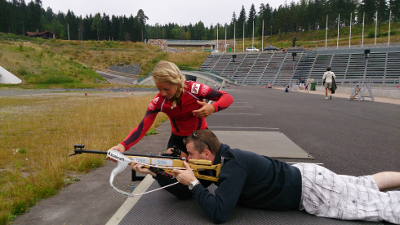
I would like to thank the many hundred subjects that I have had the honor of helping – including the many young people that was struggling in life. A special thanks goes to Tiril Eckhoff who has been an excellent subject and effective measuring stick for what this approach can do.
The article is available as a free pdf (download or read on Scribd).
It is written as a primer to people I coach and as inspiration to those with a purpose of helping others.

When you truly don’t care what anyone thinks of you, you have reached a dangerously awesome level of freedom.
I would like to extend my deep respect for scientologists, past and present – whether they are in the church or outside or no longer consider themselves scientologists.
Because the vast majority of them have harbored at least one of two basic drives; To help others or to attain something greater than themselves.
I believe both purposes deserve credit.
These purposes are often held so strong by a scientologist that he or she is willing to tolerate serious infringement to own personal integrity. Some even sign a contract for one Billion years of service to dedicate themselves to helping others. Such acts have serious implications to one’s own mental health – but the purpose therein is nevertheless highly commendable.
Repeated breaching of one’s own integrity will make the person lose himself and eventually void his ability to help others.
My deep respect for the intention to help and to forward spirituality is coupled with my wish for scientologists to keep their integrity – in order to fulfill their purposes.
Sheldon: “Would it help if I say sorry?”
Raj: “Yes, it would”
Sheldon: “Hmmm, you should work on that”

“I haven’t read your application. Or your CV. In fact, I know nothing about you except your name. Right now you are a blank sheet of paper. Let’s start the interview“.
Katarina looked befuddled. This wasn’t exactly the start she expected. As I got back from the counter with something to drink for us both, the surprise on her face had worn off. She was ready.
I made her focus on the actual results she had achieved in her professional and personal life. I looked for relevant accomplishments. Real value generation. Measurable return. Where she had made a real difference.
And she responded like I have rarely seen. A string of great accomplishments. Amazing results. This girl could really deliver.
Out of the 6000+ interviews I have done, this was by far the best. No tools in the way, no school grades ramping up any preconceptions, no personality test scores, no spell-checked application or CV based on “marked standards”. Just Katarina.

Personality tests are frequently used as a tool in recruitment. There are pros and cons to using such tests.
I was the CEO of U-MAN in Norway from 1990 till 2000. The company’s main product was selling the Oxford Capacity Analysis as a tool in recruitment for our clients. The OCA test is controversial because it is used by the Church of Scientology and licensed from the Church of Spiritual Technology and 6% of the income from test sales is funneled to the Church of Scientology conglomerate. U-MAN, a WISE company, has later changed its name to Performia. The company has moved its testing online like so many other companies selling personality tests, IQ tests etc.
While I go into greater details regarding both WISE, U-MAN and the OCA test in my book “Nittenåttifire“, I would like to accentuate a few points here.
The OCA test is originally a fork of the Johnson Temperament Analysis (now the T-JTA). Before 1954, Hubbard used many different personality tests to validate changes and progress people had with Scientology therapies. Julia Salmen, an employee of the Church of Scientology in LA was asked by L. Ron Hubbard to come up with a personality test that would be free for Scientology to use. She started out with the JTA and added one personality trait (Certain – Uncertain) – a smart improvement as it enhanced the value of the JTA by adding an internal consistency check of sorts. The OCA test has 10 personality traits with 20 questions determining each trait (the JTA has 180 questions and 9 traits). It may be doubtful that this change actually constitute enough “new work” to void any copyright claims of the JTA.
While the JTA (and OCA) was designed as a general personality test, such tests are also frequently used as a complimentary tool in job interviews. But there is a liability in such use. A similar liability is evident when the employer relies on school grades when recruiting for a position.
When an interviewer has a candidate in front of him, her grades from school and a personality test result with scores and a nice graph, he tends to overemphasize the grades and the test results. Because it has numeric values. The numbers tend to eclipse his own observations. The candidate fades to the background while the grades and scores grabs attention. I know this both from my own recruitment processes and from watching other interviewers. I did more than 6000 test evaluations/interviews, I supervised hundreds of interviews done by others. Whenever there is a test score on the table, it takes center stage.
The OCA test is a really good test. But personality is seldom the main factor in job performance. We would often be surprised when we tested a team of people only to find out that the top performer had the worst test for the job. He could be completely unstructured, irresponsible in life, a nervous wreck and even shy. Still he was the best sales person in the company. When we focused only on selling and evaluating OCA tests, we recommended the wrong candidate for the job maybe 20-30% of the time. As we improved our recruitment services, adding tests for competence, structured interviews, better reference checking, etc. we managed to get as high as 97,4% success rate (checked with the client 18 months after placement). But – and here comes the big BUT – I am sure we missed some fantastic candidates in the process. The most amazing people have quirks, eccentricities. Some are even raving mad by normal standards.
One should be cognizant of the tools one uses. One should master the tools and never let the tools take center stage. People should be the focus of attention.
For what it’s worth, I leave you with a book I wrote while I worked in U-MAN – The Evaluator’s Bible.
In the next blog post, I will relate a recent story of a very different interview I had with an amazing person.
I place on the top book shelf, albeit a notch below “Jonathan Livingston Seagull“, among books that has had deep impact on my views – the remarkable “Logicomix“.

An epic search for truth, through the eyes of Bertrand Russel rendered in an epic form. The blending of the foundational quest in mathematics and the aesthetics of great comic artwork. It is easy to understand why this book has been given awards across the boards – it presents deep concepts in an ingenious and simple way.

We are taken through the basic concepts of foundational logic – from Aristotle to the modern masters such as Bertrand Russel, Alfred North Whitehead, Ludwig Wittgenstein and Kurt Gödel.
The genius of Wittgenstein was news to me. He represents some fascinating insight into the foundations of so called reality and its limitations.

… because:

And the quest culminates with the profound realization og Gödel in his incompleteness theorems. I have covered this before, but a clearer summary of what I consider to be Man’s greatest intellectual achievement to date would be along these lines:
Gödel’s first incompleteness theorem showed that a system of logic could not be both consistent and complete. According to the theorem, within every sufficiently powerful logical system, there exists a statement G that essentially reads, “The statement G cannot be proved.” Such a statement is a sort of Catch-22: if G is provable, then it is false, and the system is therefore inconsistent; and if G is not provable, then it is true, and the system is therefore incomplete.
Gödel’s second incompleteness theorem shows that no formal system extending basic arithmetic can be used to prove its own consistency. Thus, the statement “there are no contradictions in the system H” cannot be proven in system H unless there are contradictions in the system (in which case it can be proven both true and false).
This is precisely why the “the meaning of the world does not reside in the world“. Which in essence gives a foundation for free will.
 Geir Isene - uncut